Anxiety isn't something you need to manage alone. If racing thoughts, physical tension, or overwhelming worry has become part of your daily life, you're not the only one facing this challenge in Dallas-Fort Worth. Whether you're struggling with social anxiety, generalized anxiety disorder, or panic attacks, access to proper treatment can make a meaningful difference.
Mind Above Matter provides comprehensive anxiety treatment programs across the Dallas-Fort Worth area, including Intensive Outpatient Programs (IOP) and Partial Hospitalization Programs (PHP) designed to help you regain control and build lasting coping skills.
Anxiety is your body's natural response to perceived threat or stress. In small doses, it can actually be helpful, keeping you alert and focused. But when anxiety becomes persistent, intense, or interferes with work, relationships, or daily activities, it crosses from a normal stress response into something that needs professional attention.
Anxiety might show up as:
The good news: anxiety is one of the most treatable mental health conditions. The National Institute of Mental Health reports that about 19.1% of American adults experience anxiety disorders in a given year, and the vast majority respond well to evidence-based treatment. Effective treatment combines proven therapeutic techniques, sometimes medication, and practical skills you can use in real situations.

When you seek anxiety treatment in Dallas-Fort Worth, you'll likely encounter several evidence-based approaches. Understanding how they work can help you make an informed choice about what's right for your situation.
Cognitive behavioral therapy is one of the most researched and effective approaches for anxiety disorders. CBT works by helping you identify the thought patterns that fuel anxiety, then gradually changing how you respond to these thoughts. Rather than trying to eliminate anxiety completely, CBT teaches you to notice anxious thoughts without judgment and respond to them differently.
Exposure therapy, often used alongside CBT, involves gradually facing the situations or thoughts that trigger anxiety in a safe, controlled environment. For example, someone with social anxiety might practice brief conversations in low-pressure settings, then gradually work up to larger social situations or public speaking. This isn't about forcing yourself into panic; it's about systematically learning through real experience that the feared situation isn't as dangerous as anxiety suggests.
DBT combines CBT techniques with mindfulness and acceptance strategies. It's particularly helpful if anxiety is paired with emotional regulation challenges or if you've struggled with anxiety for a long time. DBT teaches specific skills for managing intense emotions, tolerating distress, and improving relationships. The four core skill modules are mindfulness, distress tolerance, emotion regulation, and interpersonal effectiveness.
Many people benefit from medication alongside therapy. Antidepressants, particularly SSRIs (selective serotonin reuptake inhibitors) like sertraline or escitalopram, are frequently prescribed for anxiety because they're effective, have a manageable side effect profile, and aren't addictive. They work by helping regulate neurotransmitters in your brain that influence mood and anxiety responses.
Anti-anxiety medications like benzodiazepines are sometimes used short-term (usually a few weeks), especially during the early stages of treatment when symptoms are most intense. They're not typically recommended as long-term solutions because of dependence risks, but in the right context, they can help you stabilize enough to benefit from therapy and build coping skills.
If medication is appropriate for your situation, Mind Above Matter's psychiatrists can evaluate, prescribe, and adjust your treatment plan as your needs change and you progress through treatment.
Finding the right treatment intensity matters significantly. Not everyone needs hospitalization, but not everyone does well with weekly therapy sessions either. The appropriate level depends on symptom severity, your support system, work and family obligations, and how long you've been struggling.
An IOP is typically 9-20 hours per week, attended while living at home and maintaining work or school commitments. IOP works well if you:
In an IOP, you'll typically attend group therapy sessions focused on specific skills like anxiety management and exposure work, individual therapy sessions customized to your needs, and sometimes medication management appointments. Mind Above Matter's IOP programs for anxiety treatment in Dallas-Fort Worth include evidence-based group work on anxiety management, mindfulness practices, and real-world exposure work designed to rebuild your confidence in situations anxiety has made you avoid.
A PHP is more intensive, typically 20-40+ hours per week during business hours. You return home each evening for sleep and personal time. PHP is appropriate if you:
The PHP option at Mind Above Matter includes all the components of IOP plus more frequent individual therapy, specialized groups, and closer monitoring of progress. This level of care provides the structure and support needed when anxiety is significantly disrupting your ability to function at work, school, or in relationships.
The journey starts with a comprehensive intake evaluation. During this process, a clinician learns about your anxiety history, what specific situations or thoughts trigger your symptoms, how anxiety has affected your work, relationships, and daily life, and what you hope to achieve in treatment.
From there, your treatment team creates a personalized plan that might include:
Treatment is concrete and practical. You're not just talking about anxiety in abstract terms; you're actively learning to manage it in real-time, with your therapist's guidance and the support of peers facing similar challenges.

Many people worry about taking medication for anxiety, thinking it means something is fundamentally "wrong" with them. It's worth knowing that psychiatric medication doesn't indicate weakness or failure; it means your brain chemistry could use some support to help you function better.
SSRIs (selective serotonin reuptake inhibitors) like sertraline or escitalopram are often first-line medications because they're effective, have a manageable side effect profile, and aren't addictive. They typically take 2-4 weeks to show full benefit, which is why patience during the adjustment period is important.
Anti-anxiety medications like benzodiazepines are sometimes used short-term, especially during the early stages of treatment when symptoms are most intense. They're not typically recommended as long-term solutions because of dependence risks, but in the right context, they can help you stabilize enough to benefit from therapy.
Mind Above Matter's psychiatrists evaluate whether medication is right for you, discuss options in detail, and monitor your response carefully, adjusting dosages or trying different medications if needed to find what works best.
The Dallas-Fort Worth area has multiple Mind Above Matter locations serving Tarrant County, Dallas County, Collin County, Denton County, and surrounding communities. Whether you're in Fort Worth, Keller, Arlington, Plano, Burleson, or dozens of other DFW cities, there's likely a location near you offering both individual therapy and group programs for anxiety treatment.
Access matters significantly when treating anxiety. When treatment is close to home, you're more likely to show up consistently, stick with your treatment plan through the challenging parts, and integrate what you learn into your daily life. Mind Above Matter's school-based programs also bring treatment into familiar school environments for teens, reducing barriers and stigma that sometimes keep young people from getting help.
Starting anxiety treatment can feel intimidating, especially if you've never done therapy before. Here's what typically happens:
Day 1-2: Intake appointment where your history is discussed in detail and your treatment plan is created based on your specific needs. You'll meet your primary therapist and might start a medication evaluation if that's part of your plan.
Day 3-5: First group sessions and individual therapy sessions. You'll start learning skills relevant to your particular anxiety patterns and begin building relationships with other people in similar situations who understand what you're going through.
Week 2+: Treatment rhythm settles in. You're attending your scheduled groups and individual sessions, practicing new skills between sessions, and gradually noticing shifts in how you experience anxiety and what you're able to do.
Most people begin to feel some relief within 2-4 weeks, though meaningful change often unfolds over months as you practice new strategies and gradually face previously avoided situations. Stick with the process even when progress feels slow.
This varies based on symptom severity and how long you've been dealing with anxiety. Some people make significant progress in 3-6 months; others benefit from 6-12+ months of treatment. The goal is not just symptom reduction but building sustainable skills and confidence you can use for years to come.
Not necessarily. Some people benefit from therapy alone, especially with milder anxiety. Others find medication essential to making progress. Your psychiatrist will evaluate your specific situation and discuss whether medication makes sense for you, based on your history, current symptoms, and treatment goals.
Previous therapy attempts that weren't successful can be valuable information. It might mean trying a different therapeutic approach, working with a different therapist, or participating in a more intensive program. Mind Above Matter's treatment team has experience with people for whom standard weekly outpatient therapy wasn't enough, and they can adjust the approach accordingly.
Yes. Anxiety often co-occurs with depression, trauma, or other mental health conditions. Mind Above Matter's comprehensive programs address the full picture of what you're experiencing, not just one diagnosis in isolation. When multiple conditions are present, integrated treatment that addresses them together is typically most effective.
Your intake clinician will assess your anxiety severity, how much it's affecting functioning, your support system, work and school obligations, and other factors. They'll recommend the level of care that matches your needs. You can always step up to more intensive care if you need it, or transition down to less intensive care as your symptoms improve.
Reaching out for anxiety treatment isn't weakness; it's wisdom. You're recognizing that anxiety is real, that it's affecting your life, and that you deserve professional support in managing it. The fact that you're reading this suggests you're ready to consider getting help.
Contact Mind Above Matter today to schedule an intake evaluation, discuss your options, and get started with a treatment plan designed specifically for you. The first conversation is simple, confidential, and requires no commitment beyond learning whether their programs are right for your situation.
Anxiety is treatable. Recovery is possible. And you don't have to do it alone.
Your teenager avoids social events, won't go to school, or calls you in a panic over minor setbacks. You've tried reassuring them, but nothing sticks. The anxiety is real, and it's affecting the whole family. What you might not realize is that family therapy addresses the root of teen anxiety, not just the symptoms.
At Mind Above Matter, we work with families throughout New Jersey to treat teen anxiety through evidence-based family therapy approaches. Unlike traditional one-on-one therapy, family therapy recognizes that anxiety often involves patterns at home: parents who accidentally reinforce avoidance, siblings who enable behaviors, or family stress that creates an anxious environment.
This guide explains how family therapy works for teen anxiety, why it often works better than individual therapy alone, and what to expect when you start treatment.
Family therapy is a structured conversation between your teen, your family, and a licensed therapist. The goal is not to blame anyone, but to identify patterns in your family that might be maintaining or worsening your teen's anxiety.
Here's a concrete example: Your daughter avoids school because of social anxiety. When she refuses to go, you let her stay home to keep the peace. This feels kind in the moment. But from an anxiety perspective, you're teaching her brain that avoidance works. The anxiety wins. Next time, she's more likely to avoid, and the cycle repeats.
Family therapy interrupts this cycle. The therapist works with you and your daughter together to understand what's happening, why your daughter's brain is stuck in anxiety, and how your family can support her in facing anxiety rather than running from it.
The key principle is this: anxiety thrives in isolation and avoidance. It shrinks in connection and small, supported steps toward the things your teen fears.
According to research published by the American Psychological Association, family-based cognitive-behavioral therapy reduces teen anxiety symptoms by 56 percent, compared to 38 percent for individual therapy alone. Family involvement matters.
Anxiety is not a character flaw. It's not laziness or dramatics. It's a misfiring alarm system in your teen's brain. When your teen's brain perceives threat, it triggers fight, flight, or freeze responses, even when the situation is safe.
What many parents don't realize is that family patterns either fuel or calm this alarm system.
Parents rarely mean to make anxiety worse, but certain responses do. If your teen has a panic attack and you immediately allow them to leave school, you've taught their brain that panic means escape is possible. Next time anxiety rises, their brain will push harder for escape.
If your teen worries about a social event and you say "You don't have to go," your teen feels relief. But relief is short-lived. Avoidance strengthens anxiety long-term.
If your teen catastrophizes about a test and you spend an hour reassuring them, they feel temporarily calm. But you've reinforced the belief that catastrophizing requires reassurance. Without reassurance, they feel more anxious.
These patterns are not your fault. Parents naturally want to reduce their child's suffering. But in anxiety treatment, reducing suffering in the short term sometimes increases it in the long term.
Siblings often participate in anxiety patterns without realizing it. A sibling might make fun of your teen's anxiety ("You're being dramatic"), creating shame that makes anxiety worse. Or a sibling might be overly protective, which sends the signal that the anxiety-triggering situation is actually dangerous.
Family therapy includes siblings (when appropriate) to shift these patterns. When a sibling understands that teasing worsens anxiety, and they learn how to support their anxious brother or sister instead, the whole family environment changes.
Some families live with chronic stress: divorce, financial strain, parental anxiety or depression, or conflict. Teens absorb this stress. Their nervous systems stay activated. In this environment, teen anxiety flourishes.
Family therapy addresses both the teen's anxiety and the family factors that feed it. Sometimes this means parents working on their own anxiety, or parents learning to communicate more effectively with each other. Calmer parents create calmer households.
Family therapists in New Jersey use evidence-based approaches to treat teen anxiety. The most common are cognitive-behavioral family therapy, acceptance and commitment therapy (ACT) for families, and structural family therapy.
CBFT teaches your family to identify thoughts and behaviors that fuel anxiety, then change those patterns.
In a typical CBFT session, the therapist might ask:
Once you see the pattern clearly, the therapist helps your family interrupt it. Instead of letting your teen avoid school, you might create a gradual exposure plan: attend school for first period only, then two periods, then the full day. Your teen faces the fear in small, manageable steps while you provide support rather than escape.
This approach is grounded in science. Exposure therapy, the cornerstone of anxiety treatment, works best when family members support it rather than enable avoidance.
ACT takes a different angle. Instead of trying to eliminate anxiety, ACT teaches your family to accept anxiety while moving toward what matters.
Your teen might learn: "My brain sometimes produces scary thoughts and physical sensations. I can't control that. But I can control whether I stay connected to people I love and do things that matter to me, even when anxiety is present."
In ACT family therapy, the therapist might ask:
ACT family therapy helps families stop fighting anxiety and start living despite it. For some teens and families, this shift is powerful.
Structural family therapy looks at your family's organization. Who makes decisions? How do family members relate to each other? Are boundaries clear?
Sometimes teen anxiety reflects deeper family issues: a parent who's overly involved in their teen's decisions, or unclear roles that create confusion and stress. Structural therapy reorganizes these patterns.
For example, if a parent has been managing every detail of their teen's life, the therapist helps the parent step back and allow their teen more autonomy. This builds confidence and reduces anxiety.
When you come to Mind Above Matter in New Jersey for family therapy, here's what to expect:
First session (intake): The therapist meets with the whole family (or sometimes parents first, then the teen separately) to understand your teen's anxiety symptoms, your family history, and what you've already tried. The therapist explains how family therapy works and answers questions. This is a time to share concerns and hear what treatment looks like.
Sessions 2 onward (active treatment): Sessions are usually 60 to 90 minutes. The therapist guides conversations about anxiety, family patterns, and change. You might practice new ways of responding to your teen's anxiety. You might practice communication skills. The therapist assigns homework: journaling, tracking anxiety, practicing exposures, or reading materials between sessions.
Mid-treatment check-in: Usually around session 4 or 5, the therapist checks whether the treatment plan is working. Are anxiety symptoms decreasing? Are family patterns shifting? Do you need to adjust the approach?
Discharge and relapse prevention: As your teen's anxiety improves and family patterns shift, sessions taper. The therapist helps your family plan for setbacks and builds confidence that you can manage anxiety on your own going forward.
Maya, 15, developed severe social anxiety in her sophomore year at a high school in Bergen County. She stopped attending classes, ate lunch alone in the bathroom, and had panic attacks when forced to go to school. Her parents, exhausted and frightened, tried everything: medication, rewards for attendance, even threatening consequences. Nothing worked.
Her psychiatrist recommended family therapy alongside her medication. In her first session with her therapist at Mind Above Matter, Maya's parents learned that their well-intentioned responses had accidentally reinforced her avoidance. When Maya refused to go to school, her mom called the school and got her excused. When Maya panicked, her dad spent 30 minutes calming her down. Both responses felt helpful in the moment, but they prevented Maya from learning that she could handle anxiety.
Over eight weeks of family therapy, Maya's parents learned new skills:
Maya learned:
By week eight, Maya was attending full days at school. By week twelve, she'd joined the school's debate club. Her panic attacks nearly disappeared. Her parents felt equipped to support her without enabling avoidance.
Family therapy didn't eliminate Maya's anxiety overnight. But it changed how her family responded to anxiety, and that changed everything.
Family therapy works best for teen anxiety when:
At Mind Above Matter, we offer family therapy as part of our comprehensive mental health services in New Jersey.
Family therapy might not be the first choice if:
Most often, family therapy works best alongside individual therapy and psychiatric care. At Mind Above Matter, we coordinate all three to give your teen the best chance of recovery.
When you're looking for a family therapist, ask:
Mind Above Matter's therapists in New Jersey specialize in evidence-based family therapy for teen anxiety. We accept most major insurance plans and can usually start your family within one to two weeks of your first call.
When you call, have your insurance information ready and be prepared to describe your teen's anxiety symptoms and how they're affecting your family. This helps us determine the right therapist and treatment approach for your situation. Contact our team in New Jersey to schedule your family's first session.
Anxiety treatment is a process, not a quick fix. Most teens begin to see noticeable improvement in four to eight weeks, especially when family patterns are changing. Full recovery usually takes three to six months of consistent family therapy and practice at home. The key is that you're building skills and changing patterns, not just talking about problems.
This is common, and it's something family therapists know how to navigate. Sometimes parents benefit from starting therapy first to learn how to have difficult conversations with their teen. Other times, the therapist can meet with your teen individually first to build rapport before bringing the whole family together. Resistance often decreases once your teen feels heard and understands that the goal is to reduce their suffering, not punish them.
Yes. Family therapy and psychiatric medication are complementary. Medication can help calm your teen's nervous system enough that they can engage in therapy and practice new skills. Family therapy teaches the skills and changes patterns that medication alone cannot address. Many teens benefit from both.
Yes. If you're separated or divorced, the therapist can work with each parent separately, with both parents together, or with your teen and whichever parent is the primary caregiver. The goal is to ensure both parents (if possible) understand anxiety and respond consistently, so your teen isn't getting mixed messages.
Most families start with weekly one-hour sessions. After four to six weeks, if your teen is making progress, sessions might space to every other week. As symptoms improve and your family feels confident with new skills, sessions taper further. The exact schedule depends on your teen's anxiety severity and your family's needs.
If your teen struggles with anxiety and family patterns feel stuck, family therapy can interrupt the cycle. At Mind Above Matter, we've helped hundreds of New Jersey families build confidence, reduce avoidance, and give their teens the tools to manage anxiety.
You don't have to figure this out alone. Contact Mind Above Matter today to schedule a consultation. We'll discuss your teen's anxiety, explain how family therapy works, verify your insurance, and answer your questions. Treatment can start within days.
Your teen's anxiety is real. So is your family's ability to support recovery. Let's get started.
Contact Mind Above Matter to learn more about family therapy for teen anxiety in New Jersey.
Anxious teens usually do not need more lectures. They need concrete skills they can use before school, during conflict, and in the middle of a panic spike. That is where Dialectical Behavior Therapy, or DBT, becomes useful for families looking for real help in Texas.
Mind Above Matter uses DBT-informed care to help teens in the Dallas-Fort Worth area manage anxiety, depression, and emotional overwhelm. The approach is practical, structured, and built for real life, not just for the therapy room.
This guide explains what DBT is, why it helps anxious teens, how the core skills work, and how families can support progress at home and in treatment.
DBT was developed by psychologist Marsha Linehan and later adapted for adolescents who struggle with intense emotions, self-defeating thoughts, and avoidance behaviors. It combines acceptance with change. That balance matters for anxious teens, because shame and pressure usually make symptoms worse.
DBT is not vague advice. It is a skills-based model with specific steps, language, and practice tools. For families who want more than weekly reassurance, that structure can be a relief.
Anxiety often shows up as school refusal, social withdrawal, sleep problems, stomach pain, irritability, and constant checking for danger. The National Institute of Mental Health explains that anxiety disorders can disrupt school, work, and relationships when symptoms persist or intensify. The American Psychological Association also notes that anxiety can become self-reinforcing when avoidance takes over. Read the NIMH overview of anxiety disorders, and see the APA's anxiety resources for more background.
DBT helps because it interrupts that loop. Instead of waiting for fear to disappear, teens learn how to tolerate the feeling, regulate their body, and keep moving toward what matters.
Every DBT program is built around four skill sets. Each one supports a different part of anxiety recovery.
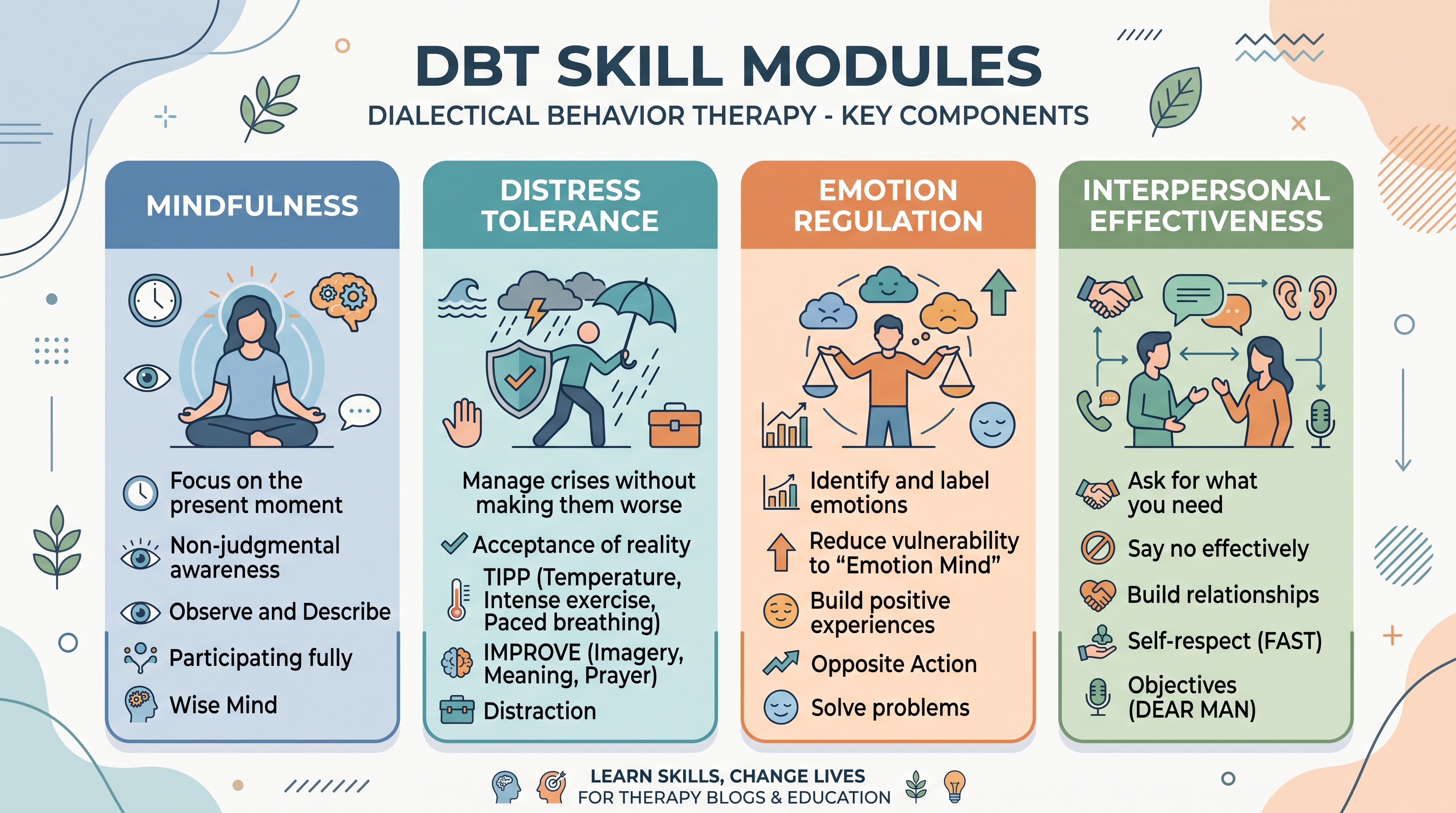
Mindfulness teaches teens to pay attention to the present moment without getting pulled into predictions or self-criticism. An anxious teen may be living three steps ahead of the actual moment, rehearsing worst-case scenarios before anything happens.
Mindfulness gives them an anchor. Five-senses grounding, paced breathing, and simple observation exercises help the nervous system settle enough for thinking to return.
A teen who can say, "I am noticing a panic feeling," is already in a better position than a teen who believes the panic is proof that something is wrong with them.
Distress tolerance is for the moments when anxiety is loud and immediate. It is not about solving the whole problem in one sitting. It is about getting through the next five minutes without making the situation worse.
DBT tools like temperature change, paced breathing, brief intense movement, and paired muscle relaxation help lower the body's alarm response. For a teen in panic, that can be the difference between spiraling and regaining enough control to ask for help.
Parents often expect a calm conversation to solve a panic attack. Usually the body has to settle first. Once the physical surge lowers, the thinking brain comes back online.
Emotion regulation teaches teens to understand what makes anxiety stronger over time. Lack of sleep, skipping meals, constant screen stimulation, and isolation all raise vulnerability. DBT names those patterns clearly so families can address them instead of treating anxiety like a mystery.
The PLEASE skill is especially useful here. It reminds teens to care for Physical health, balanced Eating, avoid mood-changing Substances, and protect Sleep. Those basics are not minor details. They are part of treatment.
Teens also learn to check the facts, name the emotion, and choose a response that fits the situation. That keeps every hard feeling from becoming an emergency.
Many anxious teens either shut down in relationships or over-accommodate everyone around them. They say yes when they mean no. They apologize when nothing went wrong. They disappear when conversations become uncomfortable.
Interpersonal effectiveness gives them scripts. DEAR MAN helps a teen ask for what they need or set a boundary. GIVE helps them stay respectful and connected while doing it. Those skills matter in friendships, at home, and in school settings where anxiety can make every conversation feel high stakes.
DBT works best when it moves out of the workbook and into ordinary moments. A teen can use mindfulness before first period, use distress tolerance in the car before a test, and use emotion regulation after a hard day online.
Picture a teen waking up with a tight chest and the thought, "I cannot do this today." Instead of staying in bed, they do a two-minute grounding exercise, splash cold water on their face, and break the morning into one step at a time. The goal is not to feel perfect. The goal is to function while anxiety is still present.
At lunch, the same teen may use interpersonal effectiveness to ask a teacher for a quiet check-in or to text a parent a clear request for support. That kind of practical communication is often missing when anxiety has been running the show.
Over time, teens begin to notice something important. They do not have to wait for a fearless version of themselves to show up. They can act while afraid, and the fear usually becomes more manageable after repeated practice.
About Us become more effective when they are taught in a structured treatment setting. Mind Above Matter's IOP and PHP programs are designed for teens who need more support than weekly therapy can provide.
In an Intensive Outpatient Program, teens attend treatment several days a week while still sleeping at home and staying connected to school and family life. In a Partial Hospitalization Program, the level of support is higher and the daily structure is more intensive. Both settings create the repetition DBT needs to stick.
Mind Above Matter uses groups, individual sessions, and family involvement to help teens practice DBT in real time. A teen can learn a skill in the morning group, test it later that day, and talk about what happened with a clinician before going home.
That kind of fast feedback matters. Anxiety rarely responds to one insight. It responds to repeated, supported practice.
Families in Keller, Burleson, and the wider Dallas-Fort Worth area often find this format easier to sustain than trying to improvise care on their own. When treatment is coordinated, everyone knows what the next step is.
Parents do not need to become therapists to help. They do need a simple plan, steady expectations, and a calm voice. DBT gives families that kind of roadmap.
Start with one skill. For many homes, mindfulness or distress tolerance is the easiest place to begin. Practice it when your teen is relatively calm so it becomes familiar before the next hard moment shows up.
It also helps to praise the process, not just the outcome. If your teen used a skill and still felt anxious, that still counts as progress. The point is not immediate comfort. The point is building confidence that anxiety can be handled.
If you need help understanding what level of care makes sense, learn more about Mind Above Matter's iMatter school-based support and how the team extends care beyond the clinic. If you are ready to talk with someone directly, contact Mind Above Matter for a consultation.
Some teens notice small changes within a few weeks, especially when they practice consistently. Bigger shifts usually take longer because DBT is teaching new habits, not just offering encouragement. Progress is often visible first in fewer blowups, better follow-through, and faster recovery after stress.
No. DBT can help teens with mild, moderate, or severe anxiety. The earlier a teen learns the skills, the easier it is to interrupt avoidance and build resilience before symptoms become deeply entrenched.
Yes. Many teens benefit from both medication and skills-based therapy. Medication may lower the intensity of symptoms, while DBT teaches the teen how to respond when anxiety still shows up.
Resistance is common. Teens often fear that treatment will be judgmental or overwhelming. A calm, practical explanation of what DBT involves, paired with a clear next step, usually works better than pressure or threats.
No, although they overlap. CBT focuses more on thoughts and behaviors. DBT adds distress tolerance, mindfulness, emotion regulation, and interpersonal effectiveness. That extra structure is especially helpful when anxiety is tangled up with big emotions or family conflict.
Mind Above Matter combines evidence-based care with a tone that feels human, not clinical and cold. That matters when a teen has already been told to "just calm down" or "try harder." The team understands that anxiety is not laziness and not defiance. It is a real condition that changes how a young person thinks, feels, and acts.
The program model also gives families more than one point of support. Teens may need help with depression, trauma, school stress, or family communication in addition to anxiety. When those pieces are treated together, progress is often steadier.
For many DFW families, the appeal is simple. They want a program that can meet a teen where they are and still move them forward with structure, consistency, and accountability.
If anxiety is interrupting your teen's life, the safest move is usually to address it early. You do not need to wait for a crisis to ask for help.
Mind Above Matter can help your family understand whether IOP, PHP, or a different level of care makes the most sense. The intake process is designed to be clear, direct, and respectful of what your teen is already carrying.
Contact Mind Above Matter today if you want a practical plan for your teen's anxiety. The right support can make school, home, and relationships feel manageable again.
Adolescence is a time of growth, but for many teens, it's also a time of struggle. Anxiety. Depression. Self-doubt. For parents watching their teen pull inward, the question isn't whether they need help—it's where to find the right kind of help.
That's where intensive outpatient programs (IOP) come in. Not hospital admission. Not once-a-week therapy that feels like checking a box. Something in between. Something structured. Something that works.
Mind Above Matter's intensive outpatient program in the Dallas-Fort Worth area is designed specifically for this moment—when a teen needs more support than a single therapy session can offer, but doesn't require inpatient hospitalization. It's the Goldilocks of adolescent mental health care: intensive enough to move the needle, flexible enough to fit real life.
Here's what families in Texas should know about IOP and why it might be the right step for their teen.
An intensive outpatient program is structured mental health treatment that happens during the day (or evening) while your teen continues living at home. Think of it as the middle ground between crisis care and traditional weekly therapy.
Your teen attends sessions three to five days per week, usually in the morning or evening depending on whether they're in school. Sessions typically include group therapy, individual check-ins, medication management if needed, and family involvement. The whole thing usually runs for four weeks, though it can be extended based on progress.
The key word is intensive. IOP isn't a substitute for hospitalization when someone is in acute crisis. But for teens managing depression, anxiety, self-harm thoughts, behavioral challenges, or trauma, it provides the structured support and professional monitoring that weekly therapy alone can't.
Here's something most parents learn the hard way: talking about feelings once a week doesn't stick.
Teens with depression or anxiety need consistent practice at healthier thought patterns. They need to practice coping skills in real situations, not just discuss them in an office. They need other teens who understand what they're going through. And they need to know someone qualified is watching their progress closely—not just hoping things improve on their own.
IOP creates a container for this work. It's intense, yes. But intensity builds momentum. A teen who attends group therapy four times a week, meets with a therapist weekly, and learns practical coping skills from trained professionals is doing fundamentally different work than one in monthly appointments.
Studies back this up. The approach works for anxiety. It works for depression. It works for teens processing trauma or struggling with self-harm thoughts. And importantly, it preserves normalcy—your teen goes home at night, attends school or work, stays connected to family and friends.
Anxiety in teens isn't just worry. It's avoidance. It's physical symptoms—the racing heart, the tight chest—that feel like proof something is seriously wrong. It's the spiral: one anxious thought becomes ten, which become "I can't leave the house" or "I can't do school."
Depression in teens isn't just sadness. It's numbness. It's isolation. It's the weight that makes everything—getting out of bed, texting a friend, doing homework—feel impossible.
IOP addresses both using evidence-based approaches:
Cognitive Behavioral Therapy (CBT): Teens learn to identify the thought-feeling-behavior loop driving their anxiety or depression. They practice catching unhelpful thoughts and replacing them with more balanced ones. They face situations they've been avoiding, gradually.
Group Therapy: Hearing other teens describe similar struggles is profoundly normalizing. "I'm not the only one who gets panic attacks in math class" is healing. So is learning from peers who've worked through the same stuff.
Family Involvement: Depression and anxiety don't happen in isolation. Family dynamics matter. IOP includes family sessions where teens and parents learn to communicate differently, support each other better, and break unhelpful patterns together.
Skills Practice: Coping skills aren't just abstract concepts. In IOP, teens practice them repeatedly under professional guidance—mindfulness, emotion regulation, distress tolerance, assertiveness. Repetition builds competence. Competence builds confidence.
Here's the honest part: sometimes the teen isn't the only one who needs to change. Parents often become so focused on managing their teen's symptoms that they accidentally reinforce the anxiety or depression through overprotection or criticism.
Family therapy in IOP helps by:
Teens who see their parents taking therapy seriously, asking for help themselves, and genuinely trying to understand are more likely to stick with treatment. Family involvement literally improves outcomes.
Some teens need medication alongside therapy. For others, therapy and skills practice are enough. The right call depends on the individual.
In Mind Above Matter's IOP program, psychiatrists or psychiatric nurse practitioners are part of the team. If your teen would benefit from an antidepressant, anti-anxiety medication, or other support, they evaluate that carefully. If medication isn't needed, they say so. The focus is always on what actually helps this teen, not a one-size-fits-all approach.
Parents often ask: "How do we fit this into our schedule?" or "What does it cost?"
Schedule: IOP typically runs three to five days per week, mornings or evenings. If your teen is in school, the evening option preserves their academic year. For homeschooled teens or those who need to be out of school, the day option works. Virtual sessions are also available for Texas residents, which removes transportation barriers.
Duration: Most programs run for four weeks before stepping down. Some teens need six weeks. Some are ready in three. The point is to move at the pace that actually supports healing, not an arbitrary calendar.
Cost: Most major commercial insurance plans and Medicaid cover IOP. Mind Above Matter handles verification and pre-authorization. For uninsured families, private pay options are available, and the team works on payment plans because access shouldn't depend on who can afford full price upfront.
IOP isn't the end. It's the beginning of something more sustainable.
After four weeks, teens step down to continued individual therapy, potentially ongoing family therapy, and ongoing medication management if applicable. Some teens return to weekly or bi-weekly therapy. Others continue with virtual support. The transition is planned from day one, so it doesn't feel abrupt.
The skills and insights from IOP stay with the teen. The confidence built during those four weeks compounds. Parents who learned new ways of supporting their teen keep practicing those approaches.
Not every struggling teen needs IOP. Some do well with weekly therapy and time. But if your teen shows any of these signs, IOP might be the right next step:
The first step isn't IOP. It's a mental health assessment. Mind Above Matter offers free, confidential assessments both in-person and virtual to determine what level of care your teen actually needs.
A: Not necessarily. Evening IOP allows most teens to maintain their school schedule and social connections. And honestly? Many teens find it validating to be in a group where everyone is working on mental health. The isolation of struggling alone often feels worse.
A: Resistance is common. Teens often don't want to admit they need help. The conversation with parents matters: "We love you. You're struggling. This program helps teens work through exactly what you're facing. We'll do this together." Starting is the hardest part.
A: Yes. Evening and weekend options exist specifically to preserve school attendance. For teens who need to step out of school temporarily, the clinical team works with families on the best approach.
A: Some improvements appear within days—better sleep, a little more energy. Real progress takes weeks. Most families notice meaningful shifts within 2-3 weeks. Four weeks is typically enough to establish new patterns.
A: The psychiatrist explains the recommendation, discusses side effects, and answers questions. The choice is yours. Many families find medication helps their teen actually engage with therapy instead of being too depressed or anxious to focus.
Intensive outpatient programs exist because one hour per week isn't always enough. Teenagers dealing with depression, anxiety, trauma, or behavioral struggles need structure. They need intensity. They need a team of professionals and other teens who get it.
Most importantly, they need to know that getting help is normal. That struggling is human. That change is possible.
If your teen is struggling with anxiety, depression, or any of the concerns above, the right move is a conversation. With yourself, your partner, your teen's pediatrician, or a professional at Mind Above Matter.
Schedule a free mental health assessment today. Understand where your teen actually stands. Explore options. Make an informed choice together.
Because here's what we know: teens who get the right support at the right time don't just survive adolescence. They thrive in it.
To qualify for an Intensive Outpatient Program (IOP), your mental health symptoms must significantly impair your daily functioning such as your ability to work, attend school, or maintain relationships without requiring 24/7 inpatient supervision. Clinical eligibility is generally met when standard weekly therapy is no longer sufficient to prevent symptom escalation or maintain stability.
Determining the right level of care can feel like a daunting task when you are already struggling with exhaustion, anxiety, or trauma. Many individuals worry that they aren't "sick enough" for a higher level of care, or they fear that seeking help will completely disrupt their life. However, mental health care exists on a continuum, and recognizing the signs that you need more than an hour of therapy a week is the first step toward reclaiming your life.
Indicators That Your Symptoms May Be "Severe Enough"
Clinical "severity" isn't just about how bad you feel; it is about how much your symptoms interfere with your activities of daily living. Professionals look for specific functional impairments when determining if a transition to a more structured environment is necessary. For many families searching for an IOP in Keller, TX, the goal is finding that "middle ground" where treatment is rigorous but allows you to remain in the comfort of your own home.
When symptoms of depression or anxiety make it nearly impossible to get out of bed, shower, or manage basic household tasks, it indicates a need for more intensive support. If you find yourself consistently calling out of work or failing to complete school assignments, your current coping mechanisms are likely overwhelmed.
If you have been seeing a traditional therapist once a week for several months but find that your panic attacks are increasing or your mood is consistently dipping lower, the "dosage" of your therapy may need to increase. During a recent clinical review for a program in Keller, we noted that many patients wait until they are in a total crisis before realizing that a standard therapy hour isn't enough to manage complex trauma or co-occurring disorders.
A major red flag is the escalation of avoidance behaviors or unhealthy coping strategies. This might include social isolation, substance use to numb emotional pain, or an increase in intrusive thoughts. When these behaviors begin to feel outside of your control, a structured outpatient program provides the necessary containment and safety.
While both programs offer more support than traditional therapy, they serve different clinical needs. Understanding which one fits your "severity" level is part of the initial assessment process.
Partial Hospitalization Program (PHP):
Designed for individuals with high acuity needs, including those who require medical stabilization or are experiencing significant challenges with safety or daily functioning. PHP provides intensive, structured care, typically consisting of 5 to 6 hours per day, 5 days per week, in a daytime treatment setting. This level of care is best for individuals who need substantial support but do not require 24/7 inpatient hospitalization.
Intensive Outpatient Program (IOP):
Intended for individuals with moderate acuity, who may struggle with daily tasks but are still stable enough to work, attend school, or manage part-time responsibilities. IOP offers a more flexible structure, usually involving around 3 hours per day, several days per week, with a strong emphasis on skill-building and coping strategies.
How to Choose the Right Level of Care:
If you find that your symptoms are so intense that you cannot safely navigate a full day without professional intervention, you might look into the PHP Keller, TX, provides. However, if you are stable but "stuck" and need a high-frequency skills-based environment, an IOP is often the most effective choice.
We believe that no one should have to guess whether they qualify for help. This is why we utilize our proprietary framework, The Clinical Compass, to navigate each individual's path to wellness. With over 10 years of experience providing behavioral health care in the Dallas-Fort Worth area, we have developed a methodology that focuses on the individual, not just the diagnosis.
Our organization offers both Partial Hospitalization Programs (PHP) and Intensive Outpatient Programs (IOP) designed for structured outpatient care. We serve a diverse demographic, with programs available for adolescents, teens, and adults ages 9 and up. Whether you are a student struggling in the classroom or an adult balancing a career with trauma recovery, The Clinical Compass ensures your care plan is as unique as your thumbprint.
Every journey begins with a comprehensive mental health assessment. This isn't a "check-the-box" intake; it is an in-depth evaluation designed to create a personalized care plan. Our services are robust, including:
One of the biggest fears people have when seeking a Keller, TX IOP is the loss of their autonomy. We have designed our programs specifically to minimize disruption. We believe that healing should happen alongside your life, not instead of it.
Our care is delivered through in-person programs at our Texas locations and virtual therapy options for those who need more flexibility. This allows our participants to continue school, work, or daily responsibilities while receiving the care they need.
For families looking for a Keller, TX PHP or IOP for their children, we offer a specialized bridge. Our school-based iMatter program provides proactive mental health support directly within partner school districts. By integrating with the student's existing environment, we can support their healing while they remain engaged in their education.

A common misconception in the mental health industry is that you must hit "rock bottom" before you are eligible for an intensive program. Many people believe that unless they are at risk of immediate self-harm or have been hospitalized, they "don't deserve" a spot in an IOP.
This myth prevents thousands of people from getting help when it is most effective: before the crisis hits. You do not have to be in a total emergency to qualify. Seeking an Intensive Outpatient Program is a proactive choice to prevent a crisis, much like seeing a specialist for a physical ailment before it requires surgery.
The goal of our treatment is not just to "fix" a symptom but to build a foundation of lasting healing. Through a combination of group sessions, individual therapy, family therapy, and skill-building activities, our clients develop:
Progress is continuously monitored, and treatment plans are adjusted as clients improve. We also believe that healing doesn't happen in a vacuum. Family involvement and support system participation are heavily integrated into the treatment process when appropriate, ensuring that your home environment becomes a place of continued recovery.
Does insurance cover these programs?
Yes. To ensure our services are accessible, most major insurance plans and Medicaid are accepted. We are committed to reducing financial barriers to treatment.
Will I have to quit my job to attend an IOP?
In most cases, no. Our programs are designed to be flexible. Many of our adult clients continue to work while attending evening or part-time morning sessions.
How long does a typical program last?
The duration is based on your personalized care plan and progress. Typically, a client might spend 6 to 12 weeks in an IOP, depending on their clinical needs and goals.
What is the age range for your programs?
We offer specialized tracks for adolescents, teens, and adults starting at age 9. Each age group has its own developmentally appropriate curriculum and group sessions.
Taking the first step in your mental health journey is an act of courage. Mind Above Matter is compassionate, supportive, and client-focused. We are dedicated to providing trustworthy, personalized mental health care, delivered in environments that feel familiar and comfortable. Our goal is to be a reliable partner in each client’s healing journey. We believe in making mental health care accessible and personalized. Trust is at the heart of our approach, and we are committed to reducing barriers to treatment. Whether you are seeking care in a school, home, or clinic setting, our programs are designed to minimize disruption and foster lasting healing. You deserve to feel safe, supported, and empowered. We want you to feel confident and reassured as you take control of your mental health. Our tone is always warm, empathetic, and reassuring, because we have been there, and we know the way forward.
Take the first step today. Reach out to us for more information, schedule an evaluation, and explore how our programs can fit into your life. We are here to offer the experienced guidance you need through challenging times.
Finding a trauma therapist without a long waitlist requires shifting your search from individual private practices to structured outpatient programs like PHP or IOP, which maintain higher clinical capacities. By choosing a multidisciplinary facility rather than a solo practitioner, you can often secure a comprehensive mental health assessment and start evidence-based trauma treatment within days rather than months.
The search for specialized care often feels like a secondary trauma itself. You recognize the need for help, but every phone call ends with a "six-month waiting list" or a "not accepting new patients" recording. This is especially true for those seeking trauma-informed care, where the bond between therapist and client is sensitive and specialized. The bottleneck usually exists in the traditional weekly therapy model; however, when you expand your search to encompass more robust, structured environments, the doors to healing often open much faster.
To solve the problem, we must understand the mechanics of the modern mental health landscape. Most solo practitioners in the region can only manage a set number of hours per week. Once those slots are filled, they have no choice but to start a waitlist.
Conversely, structured outpatient centers operate on a team-based model. Instead of one person managing forty clients, a multidisciplinary team manages a community of healing. During a recent audit for a firm in Keller, we found that clients often wait 70% longer for a solo therapist than they do for a structured program that offers the same, if not more, clinical contact hours.
If you are facing symptoms that feel unmanageable, such as flashbacks, severe anxiety, or co-occurring disorders, waiting three months is not a viable medical option. This is where Intensive Outpatient Programs (IOP) and Partial Hospitalization Programs (PHP) serve as the "fast track" to recovery.
Because these programs are designed for higher acuity and more frequent contact, they prioritize rapid intake. At a facility providing mental health services in Keller, TX, families rely on the goal to move a client from the initial phone call to a comprehensive assessment in a matter of days.
At our organization, we don't just provide therapy; we provide a roadmap. We use a proprietary framework called The Clinical Compass to ensure no one gets lost in the "waitlist wilderness." With over 10 years of experience providing behavioral health care in the Dallas-Fort Worth area, we have refined a system that bridges the gap between crisis and long-term resilience.
Our approach to Keller mental health services is built on the belief that access should be immediate and personalized. The Clinical Compass ensures that from the moment you contact us, your journey is mapped out across our continuum of care.
Our programs are available for adolescents, teens, and adults ages 9 and up. We recognize that trauma looks different at age 10 than it does at age 40. By integrating various services under one roof, we eliminate the need for you to find three different providers for three different needs. Our services include:
The biggest barriers to finding a therapist are usually time, location, and money. We have engineered our model to dismantle all three.
Healing shouldn't depend on your zip code. We provide care through in-person programs at our Texas locations, but we also offer robust virtual therapy options. Whether you are seeking Keller, TX mental health services locally, attending locals attending in person, or you prefer the safety of your home, the quality of care remains identical.
A common pain point for those seeking Keller mental health services is the "out-of-network" hurdle. To combat this, we accept most major insurance plans and Medicaid. We believe that trauma-informed care is a right, not a luxury reserved for those who can pay high cash rates.

For families with children ages 9 and up, the wait for a school-compatible therapist can be even longer. Our iMatter program provides proactive mental health support directly within partner school districts. By bringing the therapy to the student, we minimize the disruption to their education and provide support in the environment where they spend most of their time.
Traditional therapy can sometimes feel like "venting" without a plan. In a structured outpatient setting, the focus is on evidence-based skill building. Clients develop:
Treatment begins with a comprehensive mental health assessment and a personalized care plan. We don't believe in a one-size-fits-all approach. As you improve, your progress is monitored, and your treatment plan is adjusted dynamically.
Why is it so hard to find a trauma-informed therapist right now?
There is currently a high demand for specialized care, and many individual providers have reached their maximum caseload. Choosing an organization with multiple clinicians and structured programs like IOP or PHP is the most effective way to bypass these individual waitlists.
Can I still work or go to school while in an IOP?
Yes. IOP is specifically designed to fit into your life. With sessions typically lasting three hours a few times a week, most adults and students can maintain their daily responsibilities while receiving high-level care.
Is trauma-informed care different from regular therapy?
Absolutely. Trauma-informed care assumes that a client's symptoms are often adaptations to past overwhelming stress. It focuses on nervous system regulation and safety first, ensuring that the therapy itself does not become a source of retraumatization.
What if I need more help than just once a week, but don't want to stay in a hospital?
PHP (Partial Hospitalization) is the ideal solution. It provides the intensity of a hospital stay during the day (5-6 hours) but allows you to return home every evening, maintaining your connection to your home and family.
Navigating mental health challenges is difficult, but finding help shouldn't be. Mind Above Matter is compassionate, supportive, and fiercely client-focused. We are dedicated to providing trustworthy, personalized mental health care, delivered in environments that feel familiar and comfortable. Our goal is to be a reliable partner in each client’s healing journey.
Our programs are designed to minimize disruption and foster lasting healing, whether that happens in a school, a home, or one of our comfortable Texas clinics. You deserve to feel confident and reassured as you take control of your mental health. Let us offer the warm, empathetic, and experienced guidance you need through these challenging times.
Are you ready to stop waiting and start healing? Contact us today to schedule your comprehensive evaluation and explore which of our programs is the best fit for your needs.
The primary difference between a Partial Hospitalization Program (PHP) and an Intensive Outpatient Program (IOP) for dual diagnosis is the intensity of daily clinical care. PHP offers five to six hours of comprehensive daytime treatment for acute medical and emotional stabilization. Conversely, IOP provides roughly three hours of therapy several days a week for individuals transitioning back into regular routines.
PHP vs. IOP for Dual Diagnosis: Choosing the Right Level of Care
A dual diagnosis, managing a primary mental health condition alongside severe stress, trauma, or a substance use disorder, requires highly specialized care. Because these conditions deeply intertwine and exacerbate one another, standard weekly therapy is rarely sufficient to provide the necessary support.
When weekly therapy no longer prevents symptom escalation, choosing the appropriate level of care is critical. For those researching a Partial Hospitalization Program, understanding the structural and clinical distinctions between PHP and IOP is the first step in securing the right container for healing.
The most immediate difference between a PHP and an IOP is the time commitment, which dictates the level of containment and medical supervision a patient receives. These programs vary in daily hours, weekly schedule, medical oversight, and treatment goals.
Key structural differences include:
A Partial Hospitalization Program in Keller, often called "day treatment," acts as a direct alternative to inpatient hospitalization. Patients receive the robust, multidisciplinary clinical intervention of a residential program but sleep in their own beds at night.
An Intensive Outpatient Program provides a highly structured therapeutic environment but requires fewer hours. This allows the individual to begin practicing coping skills in the real world while maintaining heavy clinical support.
Historically, the mental health field treated co-occurring disorders sequentially, asking patients to resolve immediate crises before treating underlying trauma. Clinical science has since proven that this sequential model is highly ineffective.
Integrated care is the gold standard. A legitimate dual diagnosis program treats both the primary mental health condition and the co-occurring disorder simultaneously through psychiatry and evidence-based therapies.
When evaluating Partial Hospitalization Programs in Keller, look for this integrated approach. The high contact hours of a PHP allow a multidisciplinary team to monitor how changes in coping mechanisms impact mental health symptoms in real-time.

Accessing the right level of care requires a program that seamlessly guides you through these distinct phases. This is where our proprietary framework, The Clinical Compass, drives our structured outpatient care model.
With over 10 years of experience providing behavioral health care, we offer comprehensive Intensive Outpatient Programs (IOP) and Partial Hospitalization Programs in Keller. These programs are specifically designed for adolescents, teens, and adults ages 9 and up facing anxiety, depression, trauma, stress, and co-occurring disorders.
A Continuum of Flexible Care
Effective treatment should not completely disrupt your life. Our care is delivered through in-person programs and virtual therapy options, allowing participants to continue school, work, or daily responsibilities.
Comprehensive, Personalized Treatment
Treatment begins with a comprehensive mental health assessment to build a personalized care plan. Our programs combine group sessions, clinical therapy, individual counseling, family therapy, and medication management.
Clients develop practical coping strategies, emotional regulation skills, and resilience for daily life. Progress is continuously monitored, and treatment plans are adjusted dynamically as clients improve. Family involvement and support system participation are heavily integrated when appropriate.
We also provide proactive mental health support for students directly within partner school districts through our iMatter program. To improve access to this critical treatment, most major insurance plans and Medicaid are accepted.
A dangerous misunderstanding is that an intensive outpatient program is simply a watered-down version of a PHP. When comparing standard IOPs with robust Keller Partial Hospitalization Programs, it is crucial to understand they are sequential phases of the same healing journey, not competing models.
PHP is about containment and stabilization. It provides a safe, highly supervised container to regulate the nervous system and fine-tune complex medication regimens. IOP is about integration and practice. Once stabilized in PHP, the patient uses IOP as a therapeutic anchor while re-engaging with work, school, and family dynamics.
Can I continue working while in a Partial Hospitalization Program?
Because a PHP typically requires five to six hours of attendance per day, maintaining a traditional 9-to-5 job is difficult. Most patients utilize FMLA or short-term disability. However, once stepped down to an IOP, the flexible scheduling allows most individuals to return to work.
Do dual diagnosis programs treat the addiction or the mental health issue first?
A high-quality program treats both simultaneously. Evidence-based care recognizes that severe trauma and substance use are intrinsically linked. Treating one while ignoring the other increases the risk of relapse.
How long does a PHP or IOP program usually last?
The length of stay depends entirely on clinical progress and medical necessity. A patient might spend 2 to 4 weeks in a PHP before transitioning into an IOP for an additional 4 to 8 weeks of step-down care.
Does insurance cover PHP and IOP for dual diagnosis?
Yes. Because these programs are critical components of the mental health continuum of care, they are broadly covered by commercial health insurance and Medicaid when deemed medically necessary.
Navigating a dual diagnosis can be overwhelming, but you do not have to walk this path alone. Mind Above Matter is compassionate, supportive, and fiercely client-focused. We are dedicated to providing trustworthy, personalized mental health care, delivered in environments that feel familiar and comfortable. You deserve to feel safe, supported, and empowered. We are here to offer warm, empathetic, and experienced guidance so you can feel confident and reassured as you take control of your mental health.
Take the first step toward lasting resilience today. Contact us for more information, schedule a comprehensive evaluation, and explore the programs we offer to find the perfect fit for your needs.
To ensure a trauma-informed IOP is clinically legitimate, look for Joint Commission or CARF accreditation, plus staff holding LCSW, LPC, or PsyD licenses with specific certifications in EMDR, DBT, or Somatic Experiencing. The program must prioritize "Safety and Stabilization" over "Trauma Processing" in the initial treatment phase.
What Credentials Should You Look for in a Trauma-Informed IOP?
The surge in demand for specialized mental health services is a welcome sign of reduced stigma and increased awareness. However, a saturated landscape makes it challenging to identify gold-standard programs truly equipped to handle complex trauma. You need a specialized environment that understands the neurobiology of trauma and guides healing without causing retraumatization. The quality of care directly correlates to the facility's credentials and clinical structure.
Separate a facility's operational credentials from the specialized training of its clinical staff. A clinically sound program requires both a secure administrative foundation and highly specialized providers.
Administrative credentials dictate the safety protocols, privacy standards, and ethical governance of the facility.
Searching for an Intensive Outpatient Program Keller residents can trust can feel overwhelming when recovering from severe stress, depression, or co-occurring disorders.
Trauma-informed care must be delivered by fully licensed, independent practitioners.
A standard license is not enough. Verify therapists hold specific, post-graduate certifications in trauma modalities like EMDR, TF-CBT, DBT, or Somatic Experiencing.
A comprehensive Intensive Outpatient Program (IOP) operates as a multidisciplinary team where professionals from different psychological and medical disciplines work together. Because healing from trauma often requires coordinated care, each staff member plays a distinct role in supporting treatment, monitoring progress, and ensuring patients receive evidence-based care.
Key staff roles in an IOP program include:
This team-based approach ensures that patients receive comprehensive support addressing both their psychological and medical needs throughout treatment. When evaluating the Intensive Outpatient Programs Keller options available to you, verifying this collaborative, highly credentialed team structure is essential for long-term clinical stability and safety.

Understanding credentials is only half the battle; finding an organization that integrates them into an accessible care model is the other. This is where our proprietary framework, The Clinical Compass, guides our approach.
With over 10 years of experience providing behavioral health care, we offer structured outpatient care for adolescents, teens, and adults ages 9 and up. Our programs are designed to support individuals facing anxiety, depression, trauma, stress, and co-occurring disorders through in-person and virtual therapy options.
Structured Care Without the Disruption
Effective trauma treatment should not force you to abandon your life. Exploring Keller Intensive Outpatient Programs can provide the necessary structured care without the disruption of overnight inpatient stays, allowing participants to continue school, work, or daily responsibilities while receiving high-level care.
Services include clinical therapy, group sessions, individual counseling, and medication management. Clients develop practical coping strategies, emotional regulation skills, and resilience for daily life.
A Comprehensive, Evidence-Based Curriculum
Treatment begins with a comprehensive mental health assessment to build a personalized care plan. Progress is strictly monitored, and treatment plans are dynamically adjusted as clients improve. Family involvement and support system participation are heavily integrated into treatment when appropriate.
We also extend our reach directly to students through our school-based iMatter program, providing crucial mental health support within partner school districts. To ensure high-quality care is accessible, most major insurance plans and Medicaid are accepted.
A dangerous myth is that smaller, "boutique" facilities do not need CARF or JCAHO accreditation because they offer a highly personalized approach, or that accreditation is merely a bureaucratic insurance hurdle.
This is fundamentally false. Accreditation guarantees patient safety. Unregulated facilities lack standardized protocols for crisis de-escalation, suicide risk assessment, or evidence-based treatment tracking. For trauma recovery, an unregulated environment severely risks boundary violations and retraumatization.
What is the difference between a trauma-informed IOP and a standard IOP?
A standard program focuses on generalized symptom management. A trauma-informed program understands that symptoms are often neurological adaptations to past trauma. The entire curriculum is designed to regulate the nervous system and avoid triggering a fight-or-flight response.
Do I have to talk about my trauma immediately in an IOP?
No. In a properly credentialed, trauma-informed program, the initial phase focuses entirely on "Safety and Stabilization." Deep trauma processing begins only when your clinical team determines your nervous system is ready.
Is an intensive program covered by commercial health insurance?
Yes, if the program is licensed and the care is deemed medically necessary. We accept most major insurance plans and Medicaid to maximize access and reduce barriers to treatment.
How do I know if I need PHP or IOP?
This is determined during your initial biopsychosocial assessment. If symptoms severely impact your daily function but do not require 24/7 inpatient care, PHP is recommended. If you can maintain some daily responsibilities but need more than weekly therapy, IOP is the appropriate step.
Mind Above Matter is dedicated to providing compassionate, trustworthy, and personalized mental health care. Our goal is to be a reliable partner in your healing journey, delivering care in environments that feel familiar, safe, and comfortable.
As a premier Keller Intensive Outpatient Program, we believe in making high-quality mental health care deeply accessible. Trust is at the heart of our approach. By offering flexible, individualized care that fits seamlessly into your life, whether at school, at home, or in a long-term care setting, we minimize disruption and foster lasting healing.
You deserve to feel safe, supported, and empowered as you take control of your mental health. We are here to offer warm, empathetic, and experienced guidance through challenging times.
Take the first step toward resilience today. Contact us for more information, schedule a comprehensive evaluation, and explore the programs we offer to find the perfect fit for your needs.
When you're considering therapy for addiction or mental health issues, an Intensive Outpatient Program (IOP) can be a great option. But how does it compare to inpatient rehab, and what can you expect from the program in Keller, TX? In this guide, we'll cover everything you need to know to make an informed decision about whether an IOP is right for you or a loved one.
An IOP in Keller,TX offers several distinct advantages compared to inpatient rehab. Unlike inpatient rehab, where patients stay overnight and receive 24/7 care, an IOP allows you to receive intensive therapy while still living at home or in a comfortable setting.
Key Differences:
One example of this flexibility is the story of John, a resident of Keller, TX. John struggled with alcohol addiction but couldn’t afford to take a break from his job. After researching IOP programs in Keller, he chose one that allowed him to receive therapy after work hours, giving him the freedom to balance his career and recovery. Over time, John gained the tools he needed to overcome his addiction while still attending work, proving that IOP therapy can be both effective and flexible.
Yes! One of the major benefits of Keller, TX IOP, is that they are designed to fit around your daily life. Because the program is outpatient-based, you can continue with your personal or professional commitments while participating in therapy.
Benefits of Flexibility:
Local community members in Keller have shared similar success stories of being able to maintain a healthy work-life balance while undergoing IOP treatment. Take Sarah, for example, who was attending college in Keller. She was able to take advantage of the flexible scheduling and complete her coursework while participating in her IOP, successfully managing both her academic responsibilities and her therapy.
IOP and Keller, TX, PHP programs offer a wide range of therapeutic treatments to help individuals overcome addiction and mental health challenges. The specific therapies offered will vary depending on the program, but the following are commonly included:
CBT is a cornerstone of many IOPs in Keller. This therapy helps individuals identify and change negative thought patterns and behaviors, which are often at the root of addiction and mental health issues. By working with a therapist, you can learn healthier ways to cope with stress, anxiety, and other triggers.
DBT is particularly helpful for individuals struggling with emotional regulation and those experiencing intense mood swings. This therapy teaches skills like mindfulness and distress tolerance to help individuals navigate emotional challenges without resorting to harmful behaviors.
Group therapy is a powerful tool in IOPs, providing a sense of community and mutual support. During group sessions, you’ll interact with others facing similar challenges, share experiences, and learn coping strategies from peers.

Addiction and mental health issues often affect the entire family. Family therapy in an IOP can help heal these relationships, teach communication skills, and promote a supportive home environment for recovery.
One-on-one therapy allows you to address specific challenges and goals in a private, confidential setting. This can be crucial for deepening your understanding of your addiction or mental health issues and creating a tailored recovery plan.
At Mind Above Matter, we are committed to providing compassionate and personalized mental health care to individuals in Keller, TX. Our brand is built on principles of trust, support, and healing. We offer a range of programs, including Intensive Outpatient Programs (IOPs), tailored to each client's unique needs. We believe that therapy should be accessible, flexible, and provided in a safe, comfortable environment.
Ready to take the first step toward healing? Contact us today to schedule an evaluation and learn more about how our IOP programs can support your recovery.
Emergency situations can arise, but because IOPs are outpatient-based, clients are encouraged to reach out to their therapists or attend an emergency support group session if needed. It's important to have a plan in place for such events, and many IOPs provide 24/7 support in case of emergencies.
IOPs are often suitable for those who have already completed detoxification or inpatient care. If someone is dealing with severe addiction or mental health symptoms, it may be recommended to start with inpatient rehab before transitioning to an IOP.
The duration of IOP programs can vary, but most programs typically last for 6 to 12 weeks. Some programs may offer longer-term options depending on individual needs.
Yes, if you feel that a particular IOP isn’t meeting your needs, you can discuss your concerns with your treatment provider and explore other options. Finding the right fit for your healing journey is essential.
Mental health services are essential for individuals of all ages, and children and teenagers are no exception. In Keller, TX, health clinics offer a range of services designed to support the emotional and psychological well-being of young people. From specialized therapy to family counseling, Keller offers options for children and teens seeking mental health support.
Adults struggling with anxiety can find a variety of services to help manage their symptoms. Mental health services in Keller offer counseling and therapy for anxiety disorders, which often include cognitive behavioral therapy (CBT), mindfulness-based therapies, and support groups.
Personal Story: Take Susan, a local resident of Keller, who struggled with anxiety for years. After trying various methods, she decided to seek professional help at a local clinic. Through regular therapy sessions and learning relaxation techniques, Susan was able to regain control over her anxiety and significantly improve her quality of life.
Finding a counselor in Keller who offers family therapy is easier than you might think. Many mental health clinics in the area specialize in family therapy, focusing on resolving conflicts, improving communication, and supporting the mental health of all family members.
One option in mental health services in Keller which offers tailored family therapy program. These programs are designed to help families address issues such as communication problems, trauma, and relationship struggles in a supportive and safe environment.
If you're in need of family therapy, reach out to Keller Mental Health services today to book a session. Their warm, empathetic staff will guide you through the process, ensuring your family’s unique needs are met with care.

Yes, Keller, TX, has several clinics that offer mental health services for children and teenagers. These clinics specialize in helping young people cope with the challenges of growing up, including anxiety, depression, school-related stress, and social difficulties.
Keller, TX mental health services is a provider of youth mental health, offering a safe, comfortable space for children and teenagers to express their emotions and work through challenges. They provide a range of therapies, including play therapy, behavioral therapy, and family-based interventions.
Real-Life Example: Meet Ethan, a 13-year-old who struggled with social anxiety and bullying at school. After attending therapy at Mind Above Matter, Ethan was able to overcome his fears and build healthier relationships with his peers. His family also benefited from parent-child therapy, helping them better support him at home.
Mind Above Matter is dedicated to providing personalized mental health services in Keller, TX. We offer a range of programs designed to meet the unique needs of children, teenagers, and adults. Our compassionate, supportive approach ensures that every individual feels heard and supported throughout their mental health journey. Whether you’re looking for therapy for anxiety, family counseling, or support for your child, we’re here to help.
At Mind Above Matter, we offer personalized, compassionate mental health services for individuals of all ages. Whether you're seeking support for yourself, your child, or your family, our team is here to help you on your journey to healing. With over 10 years of experience, we’re dedicated to providing trustworthy, client-focused care in a safe, comfortable environment. Reach out today to schedule your consultation or learn more about our programs!
During family therapy, you'll work with a trained therapist to address communication issues, family conflict, and other challenges. Sessions are typically conversational and designed to promote understanding and healthy communication between family members.
Several clinics in Keller, TX, offer counseling and therapy specifically designed for teenagers. Cognitive Behavioral Therapy (CBT) and mindfulness techniques are commonly used to help teens manage anxiety.
Signs that your child might benefit from therapy include changes in behavior, withdrawal from social activities, or difficulty managing emotions. A mental health professional can help assess their needs and provide support.
Feeling nervous before your first session is completely normal, and you’re not alone in this experience. Many people have concerns about sharing personal information, and it can be daunting to step into a new environment. But the good news is that this type of therapy can be incredibly supportive, even if you’re feeling unsure at first.
In this post, we’ll guide you through how this therapy can help you manage stress from work or family life in Burleson, explain what types of therapy groups are available at Mind Above Matter, and provide some helpful tips to prepare for your first session.
Work and family stress can have a significant impact on your mental health. Balancing deadlines, responsibilities, and relationships can be overwhelming. If this stress isn’t managed, it can lead to burnout, anxiety, or even depression. That’s where outpatient therapy comes in.
In Burleson Outpatient Group Therapy, you’ll have the opportunity to talk about the daily stressors you face and gain support from others who may be going through similar struggles. You’ll learn effective coping strategies, such as mindfulness, setting boundaries, and improving time management, all of which can help you reduce stress and maintain a healthy balance in your life.
One of the biggest benefits of group therapy is the sense of community it provides. You’ll connect with others in Burleson who understand what you're going through, which can help alleviate feelings of isolation. Moreover, as you share your challenges and successes, the group can help hold you accountable for implementing stress-reducing strategies. Support from others can motivate you to make positive changes in your everyday life.
.png)
At mental health services Burleson TX groups are tailored to address a variety of needs. Whether you’re dealing with grief, trauma, anxiety, or general life challenges, there’s a group for you.
Some groups are focused on specific issues, such as grief, trauma, or anxiety. These specialized groups provide targeted support, enabling participants to connect with others facing similar challenges. If you’ve experienced a loss, are navigating the aftermath of trauma, or are managing anxiety, a specialized group can offer the focused attention you need.
If you choose a specialized group, you’ll find that the members share similar experiences, making it easier to connect and feel understood. For example, in a grief group, you can openly discuss the unique challenges of losing a loved one with others who are also grieving. This shared understanding can be comforting and help accelerate the healing process.
For those unsure where to start or managing multiple concerns, a general therapy group may be the right fit. These groups address a broad range of life challenges, from relationship difficulties to work stress, and offer support to anyone seeking to improve their mental well-being. General groups can provide a sense of community while allowing you to explore different aspects of your mental health clinic Burleson TX
It’s natural to feel nervous about attending your first group therapy session. The idea of opening up in front of strangers can be intimidating, but remember that everyone in the group is there to support one another, and no one will judge you. Here’s how you can prepare:
The first thing to keep in mind is that it’s okay to be nervous. Most people feel the same way before their first session, and that nervousness is a sign that you’re taking a step toward healing. Outpatient Group Therapy Burleson is designed to be a safe and supportive space, so take comfort in knowing that you’re not alone.
Before your first session, take a moment to reflect on why you’re seeking therapy. What are your goals? What do you hope to achieve from the experience? If it helps, write down any thoughts, feelings, or concerns you’d like to share. Journaling can be a great way to get your emotions out and begin processing them before the session starts.
Your first session will likely start with introductions and a brief overview of group rules. You’ll be guided by a trained therapist who will set the tone and ensure that everyone feels comfortable. Don’t worry about sharing immediately; most groups allow you to ease into the process. You can take your time and participate when you’re ready.
If you’re feeling anxious, try arriving a little early to get settled. Taking deep breaths or using a grounding technique can help calm your nerves. It’s also helpful to remind yourself that you don’t have to share anything you’re not ready to. Group therapy is about your pace participate as much or as little as you need.
Starting Mind Above Matter can be a little intimidating, but it’s also an opportunity for growth, healing, and connection. Whether you’re managing stress from work or family life, addressing specific issues like grief or trauma, or simply looking for support, group therapy can be a powerful tool in your mental health journey.
If you’re nervous about attending your first session, remember that it’s completely normal to feel that way. With time, you’ll likely find that the group becomes a supportive environment where you can share, listen, and grow.
In Burleson, group therapy is a valuable resource for managing stress, navigating grief, and addressing personal challenges.
Ready to take the first step in your recovery? Contact us today to learn more about our outpatient therapy sessions and how they can help you manage stress, work through grief, or address other challenges you may be facing.
If you’re struggling with addiction and considering therapy, you may be wondering, "Will it work if I’m not comfortable sharing my personal experiences with others?” It’s a common concern, but the short answer is yes, it can still be beneficial even if you’re not ready to share right away.
This type of therapy can play a vital role in your recovery, providing a sense of community, support, and accountability. In this post, we’ll explore how it works, how it can help you, and how to decide if it’s the right fit for you, particularly for those in Burleson, TX.
Outpatient Group Therapy in Burleson, TX, is a treatment option where individuals recovering from addiction attend therapy sessions in a group setting, while living at home and maintaining their daily routine. This approach offers flexibility and can be a less intensive alternative to inpatient programs.
In group therapy, a licensed therapist facilitates discussions, helping participants learn coping strategies, share experiences, and support one another. While sharing is encouraged, it’s never required. Group members are there to offer support, listen, and learn from each other, creating a safe space for everyone.
If you’re not comfortable sharing your personal story in a group setting, that’s completely okay. In fact, it’s common for people to feel hesitant to open up, especially in the early stages of recovery. The good news is that group therapy can still be incredibly valuable, even if you’re not ready to share everything.
The key to the group mental health clinic in Burleson is creating a supportive environment where participants listen without judgment. While sharing your personal experiences is encouraged, it’s always voluntary. If you prefer to listen and learn from others before speaking up, that’s perfectly fine. Your participation in the group is valuable, whether you’re speaking or just listening.
Many people find that as they attend more sessions, they become more comfortable with the group. Trust is built gradually, and you may find that, over time, you feel more open to sharing. The goal is not to pressure you, but to allow you to heal at your own pace.
In group therapy, you don’t have to be the one doing all the talking. Some people contribute by offering support and encouragement to others. Others may prefer to observe and reflect on what they’re hearing. Both roles are important in fostering a healthy group dynamic, and no one is forced to share personal details if they’re not ready.

Outpatient group therapy offers several benefits that can enhance your recovery journey, especially if you’ve been struggling with substance abuse or addiction in Burleson, TX.
Addiction can often make people feel isolated, as though no one understands their struggles. In group therapy, you’ll meet others who are going through similar experiences. This shared understanding can help you feel less alone and more connected to others. You’ll find that the support of others in the group can make a huge difference in your healing process.
Take Sarah from Burleson, for example. She had been struggling with alcohol addiction for several years and was hesitant to seek help because she felt isolated in her struggles. When she joined a local outpatient group therapy program, she initially found it difficult to open up. Over time, as she listened to others and heard their personal stories, Sarah became more comfortable and began sharing her own journey. The support she received from others in the group not only helped her stay accountable but also made her feel understood and empowered. Today, she’s continuing her recovery with the support of her community.
One of the key advantages of group therapy is the accountability it fosters. By participating in group discussions and setting goals with others, you’ll feel motivated to stick to your recovery plan. The group setting encourages progress and encourages everyone to stay on track.
At the Outpatient Group Therapy Burleson, you’ll have the opportunity to learn valuable coping strategies and tools for handling triggers, cravings, and emotional challenges. These skills are shared through group discussions and activities led by a trained therapist. You’ll also benefit from hearing about others' experiences and learning what has worked for them in their own recovery.
While the group provides peer support, the therapist is there to guide and offer professional advice. The therapist can help you work through personal challenges, provide tailored coping strategies, and navigate the complexities of recovery. Having professional guidance in a group setting can be incredibly helpful in strengthening your recovery plan.
Outpatient group therapy can be a fantastic option for many people, but it’s important to understand whether it’s the best fit for your unique situation.
If you’re struggling with mild to moderate addiction or substance abuse, outpatient group therapy could be an excellent fit. It offers a balance of structure and flexibility, ideal if you have other responsibilities, such as work or family commitments, to manage. Outpatient therapy also works well for people who are transitioning from inpatient treatment and want ongoing support.
However, if you’re dealing with severe addiction or have experienced multiple treatment failures in the past, outpatient therapy might not be enough on its own. In such cases, you may need a more intensive treatment program, such as inpatient rehab or a detox facility. A professional evaluation can help determine if a higher level of care is necessary.
The best way to determine if mental health services Burleson TX, TX, are right for you is to consult with a therapist or treatment center. They can assess your current struggles, history with addiction, and overall mental health to recommend the most appropriate course of treatment. In Burleson, TX, local resources can help guide you through this decision. You can contact trusted outpatient therapy providers in Burleson for a personalized consultation.
Mind Above Matter can be a powerful tool in your recovery journey, especially if you're struggling with addiction or substance abuse in Burleson, TX. Even if you’re not comfortable sharing personal experiences right away, the supportive environment and peer connections will help you feel less isolated and more motivated. Whether you’re just starting your recovery or need ongoing support, group therapy can offer the tools, accountability, and sense of community you need to succeed.
If you're unsure whether outpatient group therapy is the right choice for you, consider reaching out for a consultation with a local professional who can help you make the best decision for your recovery.
1. Do I have to talk in group therapy?
No, sharing is not required. You can participate by listening and still benefit from others’ experiences until you feel comfortable speaking.
2. How effective is outpatient group therapy for addiction?
Outpatient group therapy can be highly effective, especially for mild to moderate addiction. It provides support, accountability, and coping strategies while allowing you to maintain daily responsibilities.
3. What is the difference between outpatient and inpatient therapy?
Outpatient therapy allows you to live at home and attend scheduled sessions, while inpatient therapy requires staying at a treatment facility for more intensive, round-the-clock care.
4. How long does outpatient group therapy last?
The duration varies depending on individual needs, but programs can range from a few weeks to several months, with sessions typically held multiple times per week.
5. Can group therapy help with mental health as well as addiction?
Yes, group therapy is often used to treat both addiction and mental health conditions such as anxiety, depression, and PTSD.
PHP vs. IOP: Understanding Your Next Step in Mental Health Treatment
Nervous About Your First Group Therapy Session? Here’s How to Prepare and Make the Most of It
Participating in a group setting can be a powerful tool for personal growth, helping individuals improve communication skills and overcome feelings of isolation. Whether you're struggling with social anxiety or loneliness, or just want to connect more effectively with others, this collaborative environment offers a unique opportunity to work through challenges in a supportive way. In this post, we’ll explore how these sessions work, how to track your progress, and how they can help you build stronger connections with those around you.
In a group setting, the Burleson Outpatient Group Therapy plays a crucial role in creating a space where every participant feels heard and supported. Here’s how they do it:
Therapists begin by establishing ground rules that promote openness, respect, and confidentiality. This creates an environment where everyone feels comfortable sharing their thoughts and emotions. When people feel safe and supported, they are more likely to open up and engage in discussions.
One of the mental health clinic Burleson TX main goals is to ensure everyone has a chance to speak. They gently encourage quieter members to share their experiences and ensure that no one dominates the conversation. This balance helps everyone feel included, valued, and part of the group.
Group therapy involves a mix of personalities, and therapists are skilled at managing these dynamics. If any tension or conflict arises, the therapist will step in to guide the conversation, keeping it respectful and productive. This helps ensure that everyone’s voice is respected and the focus remains on personal growth.
.png)
It can sometimes be hard to tell if group therapy is making a difference, but several signs show it’s working:
One of the first changes you'll notice is an improvement in how you communicate. Group therapy encourages you to express your thoughts, feelings, and needs more clearly. Over time, you may find that you’re able to communicate more effectively not only in group settings but also in your day-to-day interactions with others. For example, if you're in Burleson and you’ve struggled with making small talk at work, group therapy can help you become more comfortable in conversations, giving you the confidence to speak up when needed.
Another key indicator is how you feel emotionally. Outpatient Group Therapy Burleson can help reduce anxiety, stress, and loneliness. As you build connections with others, you may notice a sense of relief from feelings of isolation. For instance, a client in Burleson reported feeling significantly less isolated after attending group therapy, as they realized they weren’t alone in their struggles.
Feedback is a great way to gauge your progress. Therapists will often provide feedback on your growth, pointing out areas where you've made strides. Group members may also offer insights or support, which can help you see how much you've improved.
Group therapy doesn’t just help with internal growth; it’s also a great way to improve your ability to connect with others. Here’s how it can help:
If social anxiety or fear of judgment has held you back, group therapy can be incredibly helpful. By regularly practicing communication in a supportive setting, you'll build confidence in your social interactions. For example, one participant in our Burleson group sessions shared that they had never felt confident speaking in front of others. However, after attending several sessions, they not only felt more at ease in mental health services Burleson TX but also gained the courage to speak up at work meetings.
Group therapy is a great space to learn and refine communication skills. Therapists teach participants how to listen actively, express themselves assertively, and handle difficult conversations with ease. These strategies will help you connect more effectively with others, whether you’re negotiating with a colleague in Burleson or having a tough conversation with a friend.
One of the most powerful aspects of Mind Above Matter is realizing that you're not alone in your struggles. When you hear others share similar experiences, it can reduce feelings of loneliness and help you feel understood. For instance, a participant from Burleson mentioned that after hearing others talk about their challenges with social anxiety, they felt a deep sense of connection and support. This realization helped them open up and engage more fully in the group.
Participating in a supportive group setting offers an incredible opportunity to enhance communication skills, gain emotional support, and reduce isolation. Providing a safe, structured environment for individuals to share and learn fosters personal growth and stronger connections with others. Whether you’re in Burleson or any other community, this collaborative approach can be a powerful tool to improve how you connect with the world around you.
If you’re ready to start your journey and see how group therapy can benefit you, reach out to a professional therapist today. You’ll be surprised at how much you can learn about yourself and others in a group setting, and how it can enhance your ability to communicate and connect.
Deciding between group sessions and individual counseling can feel overwhelming, but it doesn't have to be. Both options offer unique benefits, and the right choice depends on your personal needs, preferences, and goals. Whether you’ve already tried individual counseling or are just starting your mental health journey, it’s important to understand how each option works and what might be most helpful for you. In this post, we’ll answer some of the most common questions to help you make an informed decision.
Outpatient Group Therapy Burleson TX is a treatment method where several people come together to work on their mental health with the guidance of a trained therapist. It typically involves 6-12 participants, and the sessions address issues such as anxiety, depression, addiction, and relationship difficulties. Group therapy offers a unique opportunity to connect with others, share experiences, and receive feedback in a supportive, structured environment.
A licensed therapist or group facilitator leads the sessions. They ensure the group stays on track, provide professional guidance, and create a safe space for participants to share and learn. The therapist helps guide discussions, mediate group dynamics, and offer insights that encourage personal growth for everyone involved.
Most outpatient group sessions include around 6 to 12 participants. Group size can vary depending on the center and the group's specific focus. Smaller groups often allow for more personalized attention, while larger groups offer a wider variety of perspectives and experiences. Either way, group sessions are designed to foster a sense of community and belonging, regardless of group size.
The size of the group can influence your experience. Smaller groups tend to allow for more one-on-one time with the therapist and deeper personal connections between members. Larger groups can offer a broader range of experiences and insights, which can be just as helpful for seeing things from different angles. It ultimately depends on your preference and what you feel will work best for your progress.
If individual counseling hasn’t worked for you in the past, participating in a group session might offer something different. It’s possible that, in individual counseling, you didn’t feel connected or supported enough by your counselor, or that you struggled with a lack of social interaction. Group sessions give you the opportunity to learn from others and receive feedback in real-time, which can make a big difference in your progress.
For many people who have struggled with individual therapy, group therapy provides a renewed sense of hope. One of the greatest benefits is the social support and shared experiences that can help you feel less isolated. By listening to others and sharing your own story, you can gain new insights and learn from different coping strategies. Additionally, the Outpatient Group Therapy Burleson offers a safe place to practice social skills, improve communication, and build confidence in your relationships with others.
.png)
Choosing a group session starts with self-reflection. Think about how comfortable you are with sharing personal experiences in a group setting. If you’re someone who enjoys hearing from others and feels energized by group interactions, you may thrive in this environment. However, if you prefer more in-depth, private conversations with a counselor, individual counseling might feel like a better fit.
It's also important to think about your specific goals. If you're looking for emotional support and the opportunity to learn from others, participating in a group session may be ideal. On the other hand, if you're dealing with complex personal issues or prefer a more tailored, one-on-one approach, individual counseling might be the better route.
Individual counseling focuses solely on your personal experiences and goals. You have one-on-one time with a therapist, which allows for more in-depth exploration of your issues. This option is great if you need a more personalized approach and want to work through specific challenges in detail. Mental health clinic Burleson, however, offers a chance to interact with others who may be going through similar struggles. You get to hear from multiple people, gaining different perspectives and learning from their experiences. It also helps to build social support and offers the opportunity to practice social skills in a safe space.
If group and individual therapy aren't quite what you're looking for, there are other options available. For example, couples or family therapy might be beneficial if you're struggling with relationship dynamics. Online therapy is another option that offers more flexibility if in-person group or individual therapy doesn't work with your schedule.
Consider the case of Emily, who had been attending individual therapy for several months but felt like she wasn’t making much progress. She struggled with social anxiety, and while talking to her therapist was helpful, she still felt isolated and alone in her experiences. Emily decided to give group therapy a try, and it made all the difference. Hearing from others who shared similar challenges and getting feedback from her group members gave her new strategies to manage her anxiety. She found comfort in knowing she wasn’t the only one facing these struggles, and it gave her the motivation to continue working on her mental health.
Mind Above Matter group of therapy and individual counseling ultimately come down to your personal preferences and goals. Group therapy can be a powerful tool for those who need social support, community, and diverse perspectives. It’s also a great option if you’ve tried individual therapy without seeing the results you hoped for. However, individual counseling remains a great choice for those who prefer one-on-one time with mental health services Burleson TX to explore personal issues in depth.
If you're still unsure about which path is right for you, consider speaking with a local therapist in Burleson, TX, who can help guide you through the decision-making process. No matter which option you choose, taking the first step toward seeking help is always a positive move.
Ready to explore your therapy options? Reach out to a local therapist today to discuss whether group therapy or individual counseling would be the best fit for your needs!
When your teenager is struggling with anxiety, depression, or other mental health challenges, the instinct is to get them help from a therapist. But here's what research consistently shows: individual therapy alone is less effective than individual therapy combined with family involvement. The family system itself is either supporting or hindering your teen's recovery, and that matters enormously.
Family therapy isn't about blaming parents or "fixing" a broken family. It's about recognizing that your teen's mental health doesn't exist in isolation. Depression, anxiety, trauma, and behavioral challenges all happen within a family context. Family therapy works because it addresses the relational patterns, communication gaps, and often-unintentional reinforcement cycles that can keep teens stuck in their struggles.
At Mind Above Matter in Dallas-Fort Worth, family therapy is built into every level of care we offer, from our intensive outpatient programs (IOP) to our partial hospitalization programs (PHP). We've seen firsthand how involving parents in the treatment process accelerates recovery and, more importantly, helps families rebuild stronger relationships once the crisis passes.
There's a lot of misconception about family therapy. Many parents worry it means they'll be blamed for their teen's struggles. Others think it's just their teen's individual therapist occasionally checking in with them. Neither is accurate.
Family therapy is a structured, evidence-based approach where a trained therapist works with the entire family system to identify patterns that might be contributing to a teen's mental health challenges and to build healthier ways of relating. The focus isn't on who's right or wrong. It's on understanding how family dynamics work and changing the ones that aren't serving anyone well.
In family therapy, the therapist helps the family see things like: How does the teen's avoidance behavior get inadvertently reinforced by a parent's overprotection? How does criticism from a parent during vulnerable moments push the teen further away? How can parents stay calm and supportive even when their teen is in crisis? These are the conversations that unlock real change.
Family therapy is collaborative. Your teen's individual therapist might use cognitive behavioral therapy (CBT) to address thought patterns driving anxiety. Meanwhile, the family therapist helps parents understand what their teen is experiencing and teaches everyone new communication skills. These approaches work together, not against each other.
Adolescence is a developmental stage where teens are simultaneously trying to become independent and still need family stability and support. When a teen develops depression or anxiety, the family often responds in understandable but sometimes counterproductive ways.
A parent might increase control to prevent further decline ("You can't go to school until you're better"), which actually increases isolation and anxiety. Or they might avoid mentioning the mental health struggles entirely, leaving the teen feeling ashamed and alone. Or they might become so focused on managing the teen's symptoms that they lose sight of the teen as a whole person.
Research shows that adolescents with depression whose parents receive psychoeducation and coaching about how to support recovery have significantly better outcomes than teens in individual therapy alone. The family context matters that much.
Family therapy changes this by helping parents understand that their teen's mental health condition isn't a personal failure on anyone's part. Depression and anxiety are real conditions with neurobiological components, environmental stressors, and learned patterns. Once parents understand this, they can shift from blaming themselves or their teen to working as a team toward recovery.
When family therapy works well, several key shifts happen over time.
Communication Improves. Many struggling teens tell us that the worst part isn't the anxiety or depression itself; it's feeling misunderstood by their family. Family therapy creates a space where teens can express what they're actually experiencing without judgment, and parents can listen without immediately trying to fix or minimize the problem. This alone is profoundly healing.
Parents Learn to Support Without Enabling. This is the crucial balance. Supporting a teen with anxiety or depression doesn't mean doing everything for them or accepting avoidance behavior. It means understanding their experience, setting boundaries that are firm and compassionate, and encouraging them to engage with treatment and gradually face fears even when it's uncomfortable. Family therapy teaches this distinction explicitly.
Trauma Patterns Get Interrupted. Many teens with depression or anxiety have experienced family conflict, criticism, or other relational pain that contributed to their condition. Family therapy creates a space to address this directly and rebuild trust. Parents often gain new perspective on how their own stress or parenting patterns affected their teen, and they become motivated to change.
Crisis Management Gets Better. When a teen is in acute distress, parents often either shut down or escalate. Family therapy coaches families in how to respond to crisis moments in ways that reduce rather than amplify the distress. Simple skills like validation, perspective-taking, and structured problem-solving can be game-changers.
Connection Deepens. As communication improves and understanding increases, families often experience genuine reconnection. The parent-teen relationship shifts from adversarial to collaborative. This isn't just nice to have; it's protective. Teens who feel genuinely connected to and supported by their family recover faster and are more likely to maintain gains long-term.
In our Dallas-Fort Worth programs, family involvement is structured into the treatment plan from day one. Here's how it typically works:
Initial Family Assessment. When your teen enters our IOP or PHP program, the clinical team meets with your whole family to understand the family history, dynamics, and specific concerns. What's the family's understanding of the teen's mental health condition? How are parents coping with stress? What patterns are currently happening? This assessment guides the entire treatment approach.
Psychoeducation. Parents need to understand what their teen is experiencing. We provide education about anxiety, depression, trauma, or whatever condition is being treated. We explain how brain chemistry is involved. We talk about the role of life stressors, past trauma, or learned patterns. Knowledge is empowering and shifts parents from a stance of blame to one of compassion and strategic support.
Weekly Family Sessions. Most families in our programs participate in a weekly one-hour family therapy session. These sessions are facilitated by a licensed therapist trained in family systems work. The focus depends on that week's needs: processing a conflict that happened, practicing new communication skills, planning how to support the teen's recovery at home, addressing grief or guilt parents might be carrying, or preparing for the teen's transition back to full independence.
Parent Coaching Between Sessions. Our clinicians also provide coaching to parents outside of formal family sessions. If a teen's anxiety is escalating, we might coach parents on how to respond. If a parent is struggling with their own mental health, we connect them to resources. This ongoing support is crucial because family therapy works best when parents are actively practicing new approaches.
Skill Reinforcement. The skills your teen learns in IOP or PHP (like cognitive behavioral therapy, DBT skills, or emotional regulation techniques) are reinforced by parents at home. Family therapists teach parents to recognize when their teen is using these skills and how to encourage continued practice.
Not every family finds family therapy easy. Some common barriers come up, and knowing about them in advance can help.
Parent Shame and Guilt. Many parents blame themselves for their teen's mental health struggles. "What did I do wrong?" is an incredibly common thought. Good family therapy acknowledges these feelings while redirecting: your teen's depression or anxiety isn't a reflection of your parenting, and therapy isn't about assigning blame. It's about moving forward together. Naming and processing parent guilt is actually part of the healing.
Marital Conflict. Some families are dealing with significant marital stress or divorce alongside a teen's mental health crisis. This is really hard. But family therapy doesn't require a perfect marriage; it requires willingness to show up for your teen even amid personal challenges. Many families find that the structure of family therapy sessions provides a safe space to keep the focus on the teen's recovery, separate from marital issues.
Parent Mental Health Struggles. If a parent is dealing with their own depression, anxiety, or substance use, it affects the entire system. This is actually identified in family assessment and addressed. Sometimes parents need their own individual treatment or support to be available for their teen. This isn't failure; it's honesty and courage.
Resistance from the Teen. Some teens are initially resistant to family therapy, especially if they feel blamed or misunderstood at home. A skilled family therapist works with this resistance and creates safety for the teen to be heard. Often, once a teen experiences genuine listening from a parent in a family therapy session, resistance decreases significantly.
Let's walk through a real example to make this concrete. A 15-year-old girl enters our IOP program with significant social anxiety. She avoids school, avoids peers, and spends most of her time isolated at home.
In individual therapy, she's learning CBT: identifying anxious thoughts, examining evidence for and against these thoughts, and gradually re-engaging with social situations.
But her family therapy sessions reveal something important: her mother is also anxious and has inadvertently been reinforcing the avoidance. When the teen says "I don't want to go to school," mom says "Okay, stay home." In the short term, this reduces the teen's anxiety, so the behavior gets reinforced. But it also teaches the teen's brain that school really is dangerous and that avoidance works. The anxiety actually increases over time.
In family therapy, mom learns about behavioral activation and the "opposite action" principle from DBT. She learns that true support means being compassionate about the anxiety while gently and firmly encouraging school attendance anyway. She learns to say things like "I know you're anxious, and I'm confident you can handle it. Your therapist and I will support you through this."
Mom also explores her own anxiety and where it comes from. Perhaps she had an anxiety disorder as a teen herself. Perhaps she was overprotected by her own parents and is now trying to protect her daughter from any discomfort. Understanding her own patterns helps her make conscious choices rather than reactive ones.
Over several weeks, with this coordinated approach (individual CBT for the teen, skills practice, family therapy to change patterns, and potentially medication if needed), the teen slowly begins attending school more regularly, anxiety gradually decreases, and parent-teen relationship improves because they're finally on the same team.
This is what good family therapy does.
Family therapy becomes particularly critical in certain situations:
When a teen has been through trauma. Trauma-focused family therapy helps rebuild safety and trust after abuse or other violations have damaged family relationships.
When anxiety or depression is severe enough to require IOP or PHP. At these levels of care, involving family dramatically improves outcomes and prevents relapse.
When there's significant family conflict or estrangement. Family therapy addresses these ruptures directly and can rebuild connection even after serious hurt.
When a teen has made suicide attempts or has persistent suicidal thoughts. Intensive treatment including family therapy is necessary and potentially lifesaving.
When substance use is part of the picture. Adolescent substance use almost always involves family dynamics, and dual diagnosis treatment at Mind Above Matter includes family therapy as essential.
Ideally, yes. The more involvement, the better the outcomes. However, we work with what's available. If a parent is not in the picture or unable to participate, we involve whoever is available: the other parent, a grandparent, or another primary caregiver. Single parents absolutely can do family therapy. Blended families can participate. The key is including whoever is most involved in the teen's daily life.
This is actually when family therapy is most needed. Damaged relationships can heal with the right support and structure. A skilled family therapist creates safety so that real conversation can happen. It's not always comfortable, but it can be profoundly healing.
Some families notice shifts within the first 2-3 weeks as communication improves. Deeper pattern changes and relational healing typically take 8-12 weeks of consistent work. Family therapy is not a quick fix, but the improvements compound over time.
No. Family therapy is essential but not sufficient alone. Your teen needs individual therapy to work on their specific mental health symptoms. Family therapy addresses the system and family patterns. Both are necessary for comprehensive recovery.
This is common and actually gets addressed in family therapy. Family therapists help parents move toward shared understanding and consistent approaches. This united front is genuinely helpful for teens, even when parents have different personalities or parenting styles.
When a teenager develops serious mental health challenges, it feels like pure crisis. And it is urgent. But it's also an opportunity. Many families report that going through treatment together ultimately strengthened their relationships and their individual mental health.
Family therapy isn't punishment or admission of failure. It's a deliberate choice to support your teen's recovery in the most effective way possible and to invest in your family's long-term wellbeing. When your teen needs help, reaching out to a comprehensive program that includes family therapy can truly change the trajectory of their recovery.
If your teen is struggling with anxiety, depression, or other mental health challenges in the Dallas-Fort Worth area, Mind Above Matter offers intensive outpatient programs and partial hospitalization programs where family therapy is an integral part of comprehensive care. Our clinical team is experienced in working with families at all stages of relational healing.
Contact Mind Above Matter today to schedule a confidential family assessment. We'll listen to your family's story, assess your teen's specific needs, and discuss whether our program is the right fit for your situation. Recovery is possible, and your family doesn't have to navigate it alone.
If you or someone you know is struggling with addiction in Keller, TX, a Partial Hospitalization Program (PHP) could be the key to effective treatment. With the rise in addiction cases across the country, it’s essential to have specialized programs in Keller that provide comprehensive care to help people recover and rebuild their lives.
A Partial Hospitalization Program in Keller offers a structured and intensive treatment option for individuals with mental health conditions or addiction struggles. Unlike traditional outpatient care, PHP provides more support while still allowing clients to live at home. For those facing addiction, this is a crucial aspect, as it offers a balance of therapeutic care and personal space for healing.
In Keller, individuals participating in a PHP are guided through a range of therapies, including individual, group, and family counseling. These services help address the root causes of addiction, while also teaching clients essential coping skills and strategies to manage triggers and stressors in real-life scenarios. Moreover, PHPs allow for close monitoring of progress while offering a safe and familiar environment for recovery.
Take, for instance, the story of Jenna, a resident of Keller who was battling a severe alcohol addiction. By enrolling in a Partial Hospitalization Program, Jenna received personalized therapy tailored to her needs. The structure of the program helped her stay committed to her treatment plan while still maintaining a connection to her family and friends. Over time, Jenna was able to regain control of her life, using the tools she learned in the PHP to stay sober and healthy.
PHPs are designed to address a range of mental health issues, including but not limited to:
By focusing on these conditions through structured treatment and therapy, Partial Hospitalization Programs Keller provide a well-rounded approach to mental health and addiction care.

Yes, Keller Partial Hospitalization Programs offers several programs specializing in addiction treatment. These programs provide the necessary medical supervision, therapy, and support that individuals need to recover from substance abuse.
One of the key advantages of PHPs in Keller is the flexibility they offer. These programs are designed to fit around a person’s life, allowing them to engage in therapy while still managing daily responsibilities. For individuals like Mark, a local resident of Keller, the ability to receive care without leaving home made a huge difference in his recovery. Mark was able to attend his sessions and participate in group therapy, all while feeling connected to his community and family.
Moreover, PHPs that specialize in addiction treatment in Keller often incorporate various therapeutic modalities, including cognitive-behavioral therapy (CBT), dialectical behavior therapy (DBT), and holistic treatments like yoga or mindfulness. These therapies help clients work through emotional and psychological barriers to their addiction, while also providing life skills training to prevent relapse.
If you’re considering treatment for addiction, it’s important to find a program that offers personalized care tailored to your needs. The Keller Partial Hospitalization Program is designed to help people heal in ways that work for them, offering a supportive environment for lasting recovery.
At Mind Above Matter, we specialize in compassionate, client-focused mental health services. Our team is dedicated to offering personalized care in safe, familiar environments, whether in a school, home, or long-term care setting. We believe in reducing barriers to treatment and offering the flexibility needed to support lasting healing. Contact us today to start your journey toward a healthier mind and a brighter future.
Contact us today to learn more about the Partial Hospitalization Programs available in Keller and how they can help you or your loved one heal.
1. What is the difference between Partial Hospitalization and inpatient care?
Inpatient care requires a person to stay at the facility 24/7, while Partial Hospitalization Programs allow individuals to receive intensive treatment during the day and return home in the evening. This flexibility makes PHPs a great option for those who need support but want to maintain some level of independence.
2. How long does a Partial Hospitalization Program typically last?
The duration of a PHP can vary depending on the individual’s needs. Typically, programs last anywhere from a few weeks to several months, with some individuals needing extended care.
3. Will insurance cover a Partial Hospitalization Program?
Many health insurance plans provide coverage for Partial Hospitalization Programs, especially for those being treated for addiction or mental health disorders. It’s best to check with your insurance provider to understand the specifics of your coverage.
4. What can I expect during a typical day in a Partial Hospitalization Program?
Each day in a PHP typically includes therapy sessions, group activities, skill-building workshops, and time for individual reflection. You’ll work closely with a team of therapists, counselors, and medical staff to create a personalized treatment plan for recovery.
If you're considering an Intensive Outpatient Program (IOP) for addiction or mental health issues in Keller, it's natural to have many questions. The Outpatient Program provides structured treatment while allowing you to continue your daily responsibilities, such as work or school. But is it the right fit for you? Let’s explore how to determine if an IOP is the ideal treatment option for you in Keller, TX.
An Intensive Outpatient Program at Keller can be a game-changer if you're facing challenges with addiction or mental health. But how do you know if it’s the right path for you? Here are a few key indicators:
Take the example of Sarah, a Keller resident who was struggling with anxiety and depression but wanted to continue her full-time job as a marketing professional. After consulting with a mental health professional, Sarah was referred to an IOP. It was the perfect fit, offering her therapy sessions in the evenings and allowing her to receive the support she needed while continuing with her life.
If you feel like you have a mild to moderate condition and you’re ready to commit to a structured program, an IOP may be right for you. However, it’s essential to consult with a healthcare professional who can evaluate your unique situation and guide you through the decision-making process.
Yes! One of the biggest benefits of an Intensive Outpatient Programs Keller is the ability to maintain your regular routine. In Keller, you can attend therapy sessions at times that fit your schedule, whether evenings or weekends, without taking time off from work or school.
This flexibility makes IOP a highly effective option for individuals who want to continue with their daily activities while receiving professional help. For example, many IOP centers offer flexible scheduling, such as evening or weekend therapy sessions, so you can still meet your commitments.
In fact, many clients find that keeping a routine, including work or school, is part of their healing process. Engaging in regular activities, maintaining social connections, and focusing on day-to-day tasks help them build a sense of normalcy while also making progress in their recovery.
Keller Intensive Outpatient Programs are designed to treat a variety of addiction and mental health issues, including but not limited to:
For instance, John, a local resident of Keller, struggled with anxiety and alcohol dependency. He was able to balance his full-time job with a Keller Intensive Outpatient Program that treated both his mental health and addiction issues. Through a combination of individual therapy and group support, he found a path toward recovery while staying on track with his professional goals.

An IOP is structured yet flexible, with several key elements that make it an effective treatment choice:
Mind Above Matter is a compassionate, client-focused mental health care provider based in Keller, TX. Our mission is to support individuals through personalized treatment in comfortable, safe environments. Whether you're seeking help with anxiety, depression, addiction, or any other mental health issue, we are here to guide you through your healing journey.
Ready to take the next step? Contact us today to schedule an evaluation and explore how our Intensive Outpatient Programs can support you on your path to recovery.
People Also Ask
Yes! One of the main advantages of IOPs is their flexibility. Many programs in Keller provide evening or weekend sessions, allowing you to keep up with work or school commitments.
Inpatient treatment requires you to stay at a facility full-time, whereas outpatient treatment, like IOP, allows you to live at home and continue with your daily activities while receiving structured therapy and support.
While IOPs are excellent for mild to moderate addiction, individuals with severe addiction may benefit from inpatient treatment, where they can receive round-the-clock care.
The duration of IOPs can vary, but most programs last between 6 and 12 weeks. The intensity of the program will depend on your individual needs and progress.
FORT WORTH, TX — February 20, 2026 — Mind Above Matter, in partnership with Santé Center for Healing and a coalition of leading North Texas behavioral health providers,recently held the 2026 Resiliency & Recovery Conference of Fort Worth. This premier clinical event took place at the Lena Pope Center, bringing together licensed clinicians and interns for a comprehensive day of advanced trauma-informed training and recovery innovation.
The conference offered 6 CE hours and featured a diverse curriculum designed to address the most pressing challenges in modern behavioral health, including Opioid Use Disorder (OUD), family system dynamics, and neurobiological regulation.
Mind Above Matter Highlights Innovation in MAT
A cornerstone of this year’s program was a deep dive into Medication Assisted Recovery (MAR). Lisa Wedgeworth, Program Therapist at Mind Above Matter, presented "Benefits of Medication Assisted Recovery in Opioid Use Disorder." As OUD continues to impact communities across Texas, Wedgeworth’s session provides clinicians with essential frameworks for utilizing MAR as the gold standard for preventing overdose and stabilizing vulnerable populations, including homeless and pregnant clients.
“At Mind Above Matter, we believe in providing a 'Full-Circle' approach to care,” says Executive Director of Strategic Partnerships, Jesse Cordova. “Lisa’s presentation underscores our commitment to evidence-based practices that allow clients to resolve psychosocial stressors while maintaining physical and emotional stability.”
A Collaborative Approach to Healing
The conference featured a powerhouse lineup of industry leaders addressing a wide spectrum of recovery topics:
Commitment to Clinical Excellence
The event is supported by a robust network of 2026 sponsors, including Arise Recovery Centers, Eating Recovery Center, Well Mind Therapy Center, and Lifepoint Behavioral Health, among others. Credits are provided through the Texas Certification Board of Alcoholism and Drug Abuse Counselors and the Texas State Boards for Professional Counselors, Marriage and Family Therapists, and Social Worker Examiners.
Mind Above Matter is a premier behavioral health provider dedicated to intentional, client-centered care. Through innovative programming and community collaboration, Mind Above Matter strives to create lasting resilience for individuals and families navigating the journey of recovery.
LEWISVILLE, TX — May 1, 2026 — Mind Above Matter (MAM), a leading provider of youth and family mental health services, is proud to announce the official opening of its new headquarters and clinical center on June 1, 2026. Located at 401 N Valley Pkwy, Lewisville, TX 75067, the facility represents a strategic evolution in how the organization delivers care across North Texas.
The Lewisville center is more than a clinical expansion; it is the heartbeat of Mind Above Matter’s operations. As the organization’s new “Hub,” the facility uniquely integrates clinical programming, centralized operations, and corporate leadership under one roof. This synergy allows for a seamless transition of care, ensuring that the administrative support system is as robust and responsive as the clinical treatment provided in the classrooms.
"The countdown is ON, Lewisville," said Yossi Tress, CEO of Mind Above Matter. "We are thrilled to give you a first look at our newest home! The Mind Above Matter team is officially coming to N Valley Parkway, and we couldn’t be more excited to join this vibrant community."
Roughly double the size of the original Keller location, the Lewisville facility significantly increases MAM’s capacity for its signature Partial Hospitalization Programs (PHP) and Intensive Outpatient Programs (IOP). The strategic placement allows MAM to better serve families and school districts who require high-level, specialized wraparound services that are deeply embedded in the local community.
The expanded space serves as the operational engine for Mind Above Matter’s rapid growth, allowing the organization to maintain its high standards of care while scaling its mission to remove barriers to mental health support for the next generation.
The community is invited to watch for further updates as finishing touches are put on the space. Mind Above Matter looks forward to welcoming clients, partners, and community members to the new location.
About Mind Above Matter
Mind Above Matter is a leading provider of accessible mental health services, dedicated to providing specialized programming and wraparound support for youth and families. Through strategic partnerships and community-based clinics, Mind Above Matter strives to remove barriers to care and foster safe, thriving environments.
Media Contact:
Mind Above Matter
Email: info@mabovem.com
Website: www.mindabovematter.com
DENTON, TX — Mind Above Matter (MAM), a leading provider of restorative behavioral health services in North Texas, is proud to announce a new partnership with Denton Independent School District. This collaboration introduces the IMatter program to the district, with a primary clinical site established at Fred Moore High School.
The IMatter program is an integrated, school-based initiative designed to meet students exactly where they are. By providing Partial Hospitalization (PHP) and Intensive Outpatient (IOP) levels of care directly within the district community. IMatter bridges the critical gap between traditional weekly therapy and inpatient hospitalization.
“Our mission is to help students navigate their emotional challenges in a familiar, reassuring environment,” said Joann Gillen, Executive Director of IMatter. “By integrating our clinical team into the Denton ISD community, we ensure that students don’t have to choose between their education and their mental health. We are bringing them one step closer to whole.”
The IMatter program at Fred Moore High School offers:
This partnership addresses a growing need for accessible adolescent mental health services in North Texas. IMatter provides students with concrete coping strategies and behavioral support to stabilize in crisis and foster long-term resilience within the classroom.
For more information about the IMatter program, please visit www.mindabovematter.com or contact heal@mabovem.com.
About Mind Above Matter
Mind Above Matter provides restorative, full-circle mental health care across North Texas. Through their specialized IMatter school partnerships and clinical facilities, they are dedicated to helping adolescents and adults move closer to whole. With a focus on clinical integrity and compassionate support, Mind Above Matter is redefining the path to mental wellness.
FRISCO, TEXAS – August 7, 2025 – Mind Above Matter, a leading mental health clinic in North Texas dedicated to compassionate and evidence-based care, today announced a strategic partnership with Frisco Independent School District (FISD). This collaboration will provide comprehensive, on-site mental health services to FISD students, preparing to support them for the upcoming 2025/2026 school year.
This significant partnership comes at a time when the need for student mental health support is more critical than ever. Frisco ISD, known for its commitment to the holistic success and well-being of its diverse student population, recognizes the increasing pressures students face and the importance of accessible mental healthcare within the educational environment. This initiative directly addresses a vital need, enhancing the district’s existing support systems.
Through this collaboration, Mind Above Matter will offer essential mental health services directly within FISD campuses. This partnership is a key branch of Mind Above Matter’s iMatter program, which extends vital mental health services to students through partnerships with Texas ISDs. This innovative approach aims to significantly reduce the stigma associated with mental health while ensuring students have access to crucial support during and after school hours, eliminating the need for them to miss valuable class time for off-site treatment. Frisco ISD currently serves more than 64,000 students across its 12 high schools, 18 middle schools, 1 intermediate school, 43 elementary schools, and 3 special programs schools.
“We are incredibly proud to partner with Frisco ISD to bring accessible, high-quality mental health services directly to their students,” said Jo Gillen, iMatter Executive Director. “This collaboration reflects our shared commitment to fostering environments where every student can thrive academically, socially, and emotionally, and we are excited to begin supporting their community for the 2025/2026 school year.”
About Mind Above Matter:
Mind Above Matter is a leading mental health clinic dedicated to providing compassionate, evidence-based care to individuals and families across Texas. With convenient locations in Keller and Burleson, and virtual therapy available statewide, Mind Above Matter offers a comprehensive range of services, including Partial Hospitalization Programs (PHP), Intensive Outpatient Programs (IOP), and medication management, all designed to foster healing and promote lasting well-being.
About Frisco Independent School District:
Frisco Independent School District (FISD) is a nationally recognized school district located approximately 30 miles north of Dallas, Texas. Encompassing 75 square miles in Collin and Denton counties, including most of the City of Frisco and portions of neighboring Plano, McKinney, and Little Elm, FISD currently serves over 64,000 students across its 12 high schools, 18 middle schools, 1 intermediate school, 43 elementary schools, and 3 special programs schools. FISD is committed to providing a premier educational experience that fosters academic excellence, personal growth, and responsible citizenship within its diverse community.
Related: Navigating the Back-to-School Anxiety: A Guide for Parents and Students