
DBT Skills for Teens with Anxiety in Texas: A Guide for DFW Families
DBT Skills for Teens with Anxiety in Texas: A Guide for DFW Families
Anxious teens usually do not need more lectures. They need concrete skills they can use before school, during conflict, and in the middle of a panic spike. That is where Dialectical Behavior Therapy, or DBT, becomes useful for families looking for real help in Texas.
Mind Above Matter uses DBT-informed care to help teens in the Dallas-Fort Worth area manage anxiety, depression, and emotional overwhelm. The approach is practical, structured, and built for real life, not just for the therapy room.
This guide explains what DBT is, why it helps anxious teens, how the core skills work, and how families can support progress at home and in treatment.
What DBT Is and Why Teens Respond to It
DBT was developed by psychologist Marsha Linehan and later adapted for adolescents who struggle with intense emotions, self-defeating thoughts, and avoidance behaviors. It combines acceptance with change. That balance matters for anxious teens, because shame and pressure usually make symptoms worse.
DBT is not vague advice. It is a skills-based model with specific steps, language, and practice tools. For families who want more than weekly reassurance, that structure can be a relief.
Anxiety often shows up as school refusal, social withdrawal, sleep problems, stomach pain, irritability, and constant checking for danger. The National Institute of Mental Health explains that anxiety disorders can disrupt school, work, and relationships when symptoms persist or intensify. The American Psychological Association also notes that anxiety can become self-reinforcing when avoidance takes over. Read the NIMH overview of anxiety disorders, and see the APA's anxiety resources for more background.
DBT helps because it interrupts that loop. Instead of waiting for fear to disappear, teens learn how to tolerate the feeling, regulate their body, and keep moving toward what matters.
The Four Core DBT Skill Modules
Every DBT program is built around four skill sets. Each one supports a different part of anxiety recovery.
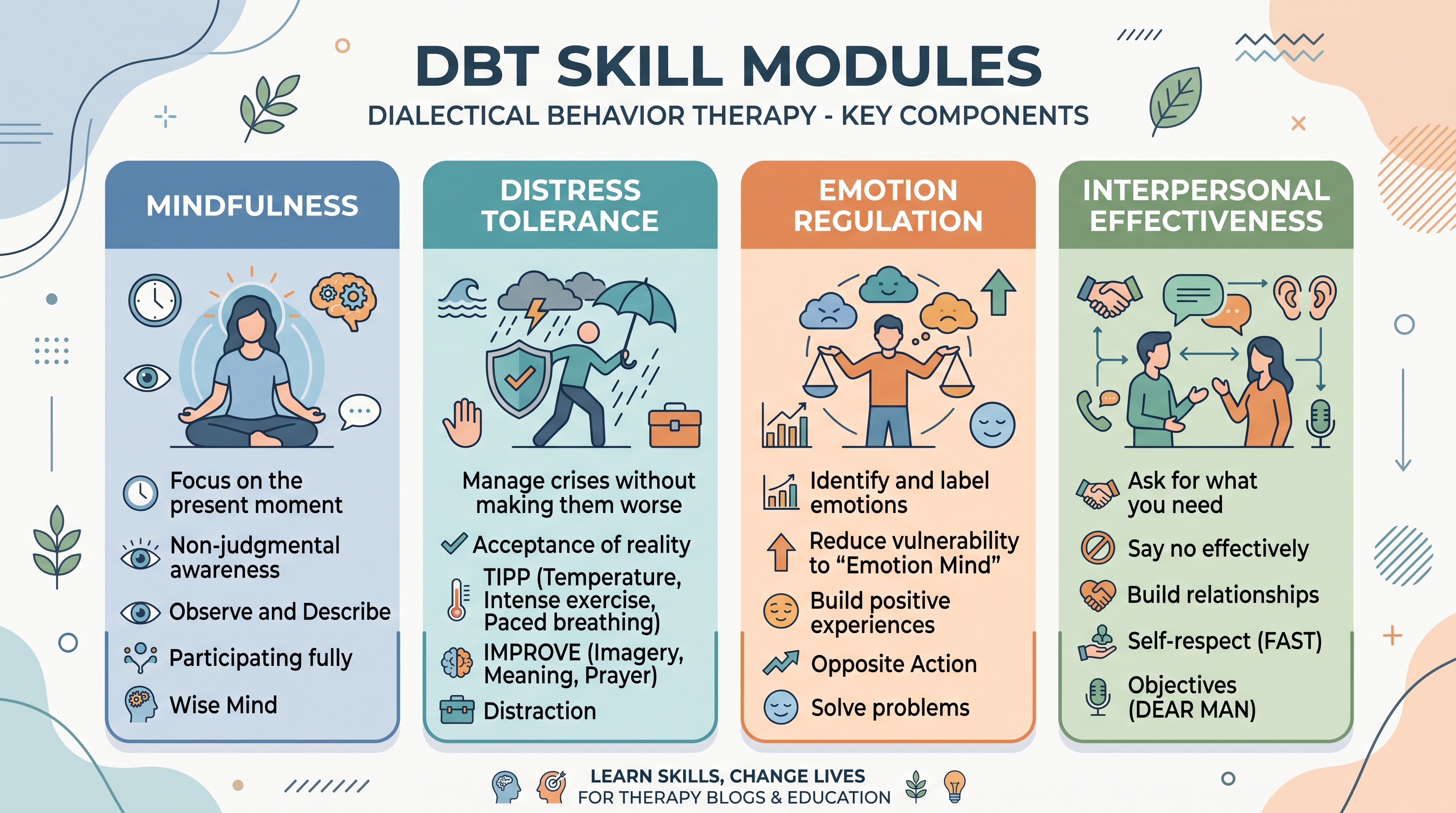
Mindfulness: Notice What Is Happening
Mindfulness teaches teens to pay attention to the present moment without getting pulled into predictions or self-criticism. An anxious teen may be living three steps ahead of the actual moment, rehearsing worst-case scenarios before anything happens.
Mindfulness gives them an anchor. Five-senses grounding, paced breathing, and simple observation exercises help the nervous system settle enough for thinking to return.
A teen who can say, "I am noticing a panic feeling," is already in a better position than a teen who believes the panic is proof that something is wrong with them.
Distress Tolerance: Get Through the Spike
Distress tolerance is for the moments when anxiety is loud and immediate. It is not about solving the whole problem in one sitting. It is about getting through the next five minutes without making the situation worse.
DBT tools like temperature change, paced breathing, brief intense movement, and paired muscle relaxation help lower the body's alarm response. For a teen in panic, that can be the difference between spiraling and regaining enough control to ask for help.
Parents often expect a calm conversation to solve a panic attack. Usually the body has to settle first. Once the physical surge lowers, the thinking brain comes back online.
Emotion Regulation: Reduce Vulnerability
Emotion regulation teaches teens to understand what makes anxiety stronger over time. Lack of sleep, skipping meals, constant screen stimulation, and isolation all raise vulnerability. DBT names those patterns clearly so families can address them instead of treating anxiety like a mystery.
The PLEASE skill is especially useful here. It reminds teens to care for Physical health, balanced Eating, avoid mood-changing Substances, and protect Sleep. Those basics are not minor details. They are part of treatment.
Teens also learn to check the facts, name the emotion, and choose a response that fits the situation. That keeps every hard feeling from becoming an emergency.
Interpersonal Effectiveness: Ask, Say No, Stay Connected
Many anxious teens either shut down in relationships or over-accommodate everyone around them. They say yes when they mean no. They apologize when nothing went wrong. They disappear when conversations become uncomfortable.
Interpersonal effectiveness gives them scripts. DEAR MAN helps a teen ask for what they need or set a boundary. GIVE helps them stay respectful and connected while doing it. Those skills matter in friendships, at home, and in school settings where anxiety can make every conversation feel high stakes.
What DBT Looks Like in Daily Teen Life
DBT works best when it moves out of the workbook and into ordinary moments. A teen can use mindfulness before first period, use distress tolerance in the car before a test, and use emotion regulation after a hard day online.
Picture a teen waking up with a tight chest and the thought, "I cannot do this today." Instead of staying in bed, they do a two-minute grounding exercise, splash cold water on their face, and break the morning into one step at a time. The goal is not to feel perfect. The goal is to function while anxiety is still present.
At lunch, the same teen may use interpersonal effectiveness to ask a teacher for a quiet check-in or to text a parent a clear request for support. That kind of practical communication is often missing when anxiety has been running the show.
Over time, teens begin to notice something important. They do not have to wait for a fearless version of themselves to show up. They can act while afraid, and the fear usually becomes more manageable after repeated practice.
How IOP and PHP Use DBT at Mind Above Matter
About Us become more effective when they are taught in a structured treatment setting. Mind Above Matter's IOP and PHP programs are designed for teens who need more support than weekly therapy can provide.
In an Intensive Outpatient Program, teens attend treatment several days a week while still sleeping at home and staying connected to school and family life. In a Partial Hospitalization Program, the level of support is higher and the daily structure is more intensive. Both settings create the repetition DBT needs to stick.
Mind Above Matter uses groups, individual sessions, and family involvement to help teens practice DBT in real time. A teen can learn a skill in the morning group, test it later that day, and talk about what happened with a clinician before going home.
That kind of fast feedback matters. Anxiety rarely responds to one insight. It responds to repeated, supported practice.
Families in Keller, Burleson, and the wider Dallas-Fort Worth area often find this format easier to sustain than trying to improvise care on their own. When treatment is coordinated, everyone knows what the next step is.
DBT Support for Teens at Home
Parents do not need to become therapists to help. They do need a simple plan, steady expectations, and a calm voice. DBT gives families that kind of roadmap.
Start with one skill. For many homes, mindfulness or distress tolerance is the easiest place to begin. Practice it when your teen is relatively calm so it becomes familiar before the next hard moment shows up.
It also helps to praise the process, not just the outcome. If your teen used a skill and still felt anxious, that still counts as progress. The point is not immediate comfort. The point is building confidence that anxiety can be handled.
If you need help understanding what level of care makes sense, learn more about Mind Above Matter's iMatter school-based support and how the team extends care beyond the clinic. If you are ready to talk with someone directly, contact Mind Above Matter for a consultation.
Common Questions About DBT and Teen Anxiety
How long does it take for DBT to help?
Some teens notice small changes within a few weeks, especially when they practice consistently. Bigger shifts usually take longer because DBT is teaching new habits, not just offering encouragement. Progress is often visible first in fewer blowups, better follow-through, and faster recovery after stress.
Is DBT only for severe anxiety?
No. DBT can help teens with mild, moderate, or severe anxiety. The earlier a teen learns the skills, the easier it is to interrupt avoidance and build resilience before symptoms become deeply entrenched.
Can DBT work with medication?
Yes. Many teens benefit from both medication and skills-based therapy. Medication may lower the intensity of symptoms, while DBT teaches the teen how to respond when anxiety still shows up.
What if my teen refuses treatment?
Resistance is common. Teens often fear that treatment will be judgmental or overwhelming. A calm, practical explanation of what DBT involves, paired with a clear next step, usually works better than pressure or threats.
Is DBT the same as CBT?
No, although they overlap. CBT focuses more on thoughts and behaviors. DBT adds distress tolerance, mindfulness, emotion regulation, and interpersonal effectiveness. That extra structure is especially helpful when anxiety is tangled up with big emotions or family conflict.
Why Mind Above Matter's Approach Works
Mind Above Matter combines evidence-based care with a tone that feels human, not clinical and cold. That matters when a teen has already been told to "just calm down" or "try harder." The team understands that anxiety is not laziness and not defiance. It is a real condition that changes how a young person thinks, feels, and acts.
The program model also gives families more than one point of support. Teens may need help with depression, trauma, school stress, or family communication in addition to anxiety. When those pieces are treated together, progress is often steadier.
For many DFW families, the appeal is simple. They want a program that can meet a teen where they are and still move them forward with structure, consistency, and accountability.
Next Steps: Getting Your Teen Support
If anxiety is interrupting your teen's life, the safest move is usually to address it early. You do not need to wait for a crisis to ask for help.
Mind Above Matter can help your family understand whether IOP, PHP, or a different level of care makes the most sense. The intake process is designed to be clear, direct, and respectful of what your teen is already carrying.
Contact Mind Above Matter today if you want a practical plan for your teen's anxiety. The right support can make school, home, and relationships feel manageable again.